The failure of the metaverse
This article is not just an indictment of modern computing, but a thesis as to why Synapse is designed the way it is. It's part of a multi-part series on the design of Synapse.
Thesis behind the design
Modern operating systems are lonely
Unusual isolation
Whether one opens their phone or their computer, modern operating systems are primarily a lonely experience in which a user individually directs themselves to different applications. Self-directed operating systems are an experience in which the user is going about their day from the perspective of all the focus being on them.
Community technology
People by nature need a sense of community. A sense not only that there are other things going on, but things that make them feel like they're part of a community.
Imagine a small internal public square between buildings. There's a couple sharing a coffee. There's a young man running his business from his laptop on a cafe table. There's a person busking with a guitar sitting on the edge of a fountain. There are two older women, sisters, talking about their day. There's a whole community, but each one is focused on their own activities.
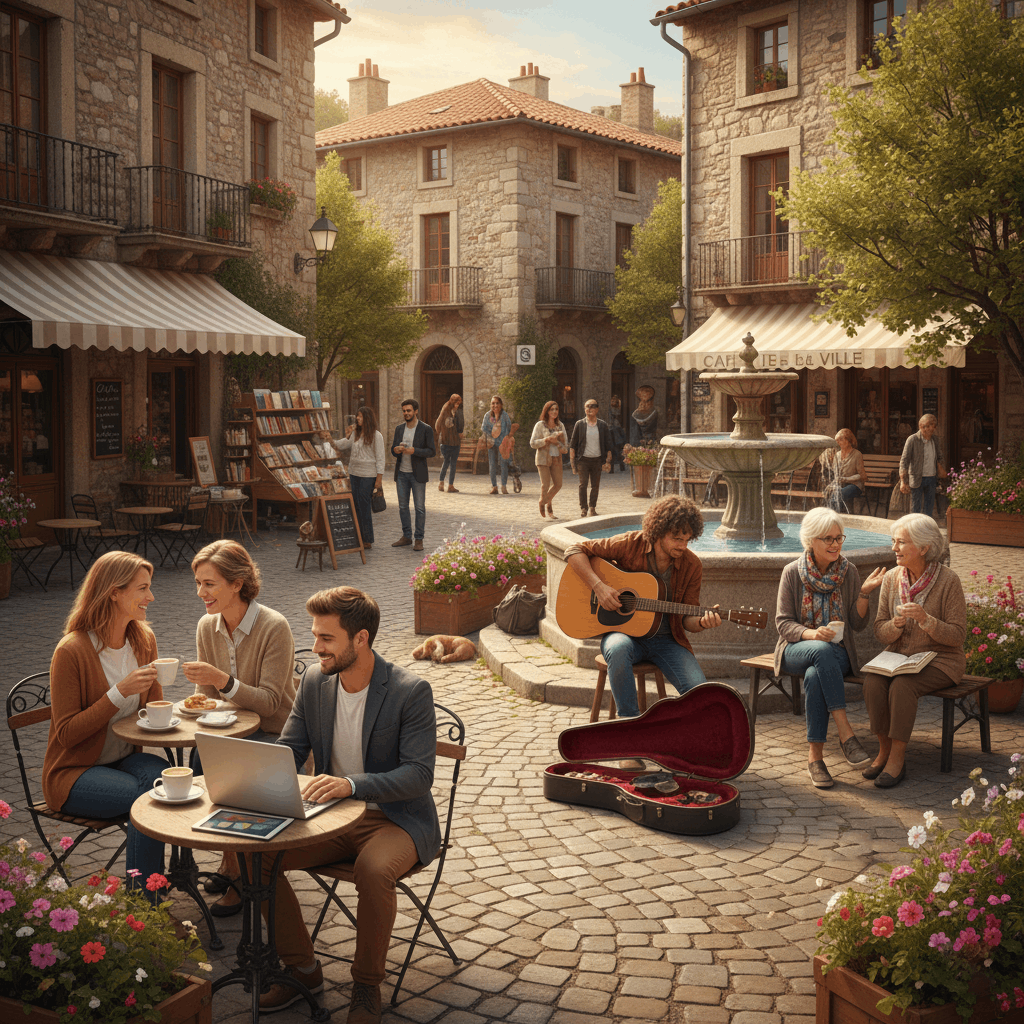
Just like a square provides a community, a space, where everyone can be themselves without necessarily talking to others. An operating system that allows you to feel connected to the actions of others can be an even more powerful one.
Why the metaverse never worked
For all the hype behind the metaverse, and all the potential for it to break the loneliness of user-driven computer experiences, tons of misunderstandings of human nature have been embodied in the concept.
Unlike gamers, people who just want to use their computer don't want to be placed in a fully immersive world for the following reasons:
(1) It's embarrassing
People's immediate reaction to being placed in a fully immersive virtual world is a feeling of being embarrassed. Going online in a virtual world is like being pushed out onto a stage.
Can people hear me right now?
Can they see me? What am I wearing?
People are terribly afraid of public speaking, especially when they don't know who they're speaking to.
(2) It's possibilities are overwhelming
Entering a virtual world is like being born all over again, as people don't inherently understand how to move their limbs or camera position. This leads to people swinging their perspective in all sorts of directions trying to get control of how to move the camera. This is not so much the case with virtual and augmented reality, but it hearkens to a fundamental issue.
Giving people the possibility to do things that are not necessary within the experience leads to choice overload. For example, the ability to look at one’s feet may not be a useful trait in using an operating system. By giving people a world of possibilities, for which they only need a few in the immediate term, one overwhelms them easily.
Overwhelming people with too many possibilities that are unnecessary to have them do what they need to do is problematic.
(3) It's cumbersome
Having to navigate a 3D world to do something that usually takes a split second is cumbersome. For example, walking down the street to the music store in a virtual world is a lot more intensive than just clicking on the music app.
(4) It's singular in nature
Running three or four applications at the same time on a computer allows you to be more productive, but this is challenging in a fully immersive virtual world.
On PC one can have a document open, and on another window a communication app, and on another one can be listening to music all at the same time. Switching between all three is a single-click experience. By contrast, it's difficult to be immersed in multiple applications at the same time in virtual worlds.
(5) It's chaotic
Too many options in a virtual space leads to disorganization.
Trying to organize 15 people to even look in the same direction in a virtual space is challenging. Each person has their own will and their own priorities and technological challenges. This leads to huge inefficiencies when trying to cooperate virtually.
Compare that to the simplicity of sending people a Zoom link and starting a presentation.
Benefits of a 3D space
The depth of connection and conversation in the 3D space are incredible. In a 2D experience, the focus always comes back to the individual user.
What are YOU going to click?
What are YOU going to interact with?
This focus on the user is practical but also isolating. It's convenient, but lonely. By contrast, virtual worlds allow you to be immersed in a group and be given the context of community and activity.
Intuitive spatial actions
Humans are built to navigate a physical world, not abstract menus. A 3D space leverages this by allowing direct, intuitive actions. For example, instead of clicking through multiple steps to send a file, one can simply pick it up and hand it to someone else, making complex tasks feel effortless and natural.
Memory of place
A person’s memory is tied to location and context. A 3D space uses this. Instead of a file path, a person remembers leaving a document in a 3D meeting room and can find it simply by going back to that spot. A book may be left on the table open to a certain page.
3D spaces create a context for memories of place. This makes technology feel less like a computer and more like an extension of one's own memory.
What users want
Simplicity: The ability to do what they desire without too many steps, too many options, or too many hassles.
Intuitive controls: The need for an interface that feels like an extension of thought, without the need for translation.
Seamless multitasking: The capacity to manage multiple activities and switch between them seamlessly.