All old article leftovers, to do list, left
To-do list
==============================================================
We must figure out how to stop people claiming that they're a member of more than one digital society and using digital legal arbitrage to confuse courts without creating a roster of all of the people who have joined digital societies thereby doing an essential census of a entire population.
2. Finish the guide to making a digital socitety including citizenship ceremony, beliefs, etc.
Copyright and patents in socities? - Add to Rubric freedom for change.
3. People's failure to be invested in online communities causes them to give in to the perpetual pressure to divide based on small differences. Cyber Sovereignty is based on enhancing this pressure to some degree, but societies must still be created and maintained, and the division process harnessed for good, and not to destroy what's being made.
The key is to give people a deep and meaningful stake in the communities they create together. Intellectual property limited to members is the mechanism by which this can be done.
CAN YOU have a top-level CySov intetual peoperty group?
4. How would restraining orders work?
How would you ensure that the delegation of power to the Accords isn't abused or is it abusable or does it cause issues?
5. Ask yourself the question, what rights do Accords have that digital societies don't and vice versa? If I get sued in a digital society, I move my money to a different digital society of the same Accord. Is there any implementation of jurisdiction both ways?
Pardons valid
Evolution of digital societies 2
==============================================================
This document must accomplish:
A clear understanding of what digital societies will start looking like.
The understanding that these are places of shared values.
the understanding that censorship is necessary to create values.
Start with how CySov interacts with values
Give examples
why the tax issue is not an issue.
The ideological clarity of Cyber Sovereignty
==============================================================
Consent
Cyber Sovereignty stands for a world in which consent is the foundation of government. Governments everywhere continually tread on the rights of individuals, and they must do so to some degree, but to truly be legitimate, they must have genuine consent from those whose rights they infringe.
Consent by nature must be explicitly and deliberately granted, with alternatives presented to be genuine.
Taxes
==============================================================
Network principle (from Taxes)
When someone joins a digital society and sets up a business, they have the right to be governed by a single body of law in the distribution of goods and taxes. Through their digital society, in which their digital society is required to remit the taxes of the corporation in question.
The current tax system for national governments to tax entirely internet-based transactions is to have entities discover where they might have a nexus of effects to the degree that they are considered taxable within a particular jurisdiction, requiring that corporation or entity to study in turn the law of every, state and sub-state, in order to do any form of business.
For example, today, an online business in the US is required to collect sales tax in any state where its sales or transaction volume exceeds a certain threshold. Because these thresholds and tax laws differ across thousands of city, county, district, state jurisdictions, companies must navigate approximately 13,000 distinct sales tax jurisdictions in the United States alone.
Multiplying this to the scale of the entire world is a recipe for disaster.
Right to demand reshoring
Thesis
Cyber Sovereignty has been created to ensure that the never-ending growth of national government doesn't come at the cost of people's freedoms. However, in creating more jurisdictions, it could create widespread lawlessness and blackholes for money.
Such a system could create widespread lack of accountability if protections aren't placed to keep people from abusing the system. The ability to sufficiently hide assets from national governments who rightfully win a court case, which has been made harder to win and doubly protected in the case of the individual, won't lead to more freedom unless further provisions are made to protect the law.
Provision
All national jurisdictions in which Cyber Sovereignty is implemented agree to allow the forcible and frictionless reshoring of financial assets in which case an individual is demanded to pay a sum for violation of a contract or legal obligation.
Core Concepts
==============================================================
⚬ What happens if there's a conflict of jurisdiction?
The party that feels the case is in the wrong jurisdiction, be it a government or society has the right to trigger the upcoming process. If the party in question is an individual then they should sue in the jurisdiction where they desire the case to be moved to and the suit will trigger this process. So if the individual wants the case to be moved to a national jurisdiction, they should sue in their national jurisdiction for the case to be moved to the national jurisdiction. Their suit is invalid if the matter has already been ruled.
Process
First, the jurisdiction that believes the other is in the wrong would state it's belief and the facts to back it up to the other jurisdiction and request the case. And the other should comply unless they genuinely believe the the first party is in the wrong. The moment that happens dispute resolution is required. If that digital society or their Accord already have a dispute resolution process in place with the national government in this regard, they should follow that process. If both jurisdictions agree completely on a process, even if it hasn't been codified, that process takes precedence as well.
Otherwise, the following is the process.
A timer is started for 7 days after the latter party rejects the other's authority.
Both the digital society and national government name 7 judges, with at least 1 outside of their jurisdiction, who they consider to be neutral and trustworthy.
Both sides take turns striking one name off the joint list, starting with the opposite side of the side that picked last time there was a previous case between the jurisdictions. To be clear every time a digital society and national government dispute the authority of a case the other side gets to start the striking process. Both sides must publish who got to pick last time and this counts not court to court but for the whole jurisdiction. The last time the national government got to pick first strike in any case in which a panel was used sets the stage for the digital society starting next time. National governments always pick the very first time but have the right to relinquish that right too.
Then both sides pick one other judge from the list that was struck out along with the final judge left over that was not struck from the list. These judges create a three-way panel that has the remaining time, or a minimum of 4 days (maximum 7), to decide if the national or digital jurisdiction has the authority to settle the case.
The side that did not get first strike in #3 determines the venue for the panel's arbitration.
The only question this panel can rule on is if the individual in question is a citizen and if the case has first-order effects outside of the digital society. To be clear, first order effects do not consider ricochet effects as mentioned earlier*. They should also discount any manipulation on behalf of any party to create effects outside of the jurisdiction in question in order to have the case moved.
The decision of the panel is final and binding and may not be re-adjudicated via a separate complaint.
This is the standard dispute process for all disputes of appropriate venue and jurisdiction between jurisdictions.
If the defending party does not start the process in 10 days, the lawsuit should continue against the defendant.
Cyber Sovereignty summary
==============================================================
Cyber Sovereignty declares that enough is enough when it comes to government infringing on the human rights of internet users.
Every internet user has a right to:
Freedom of speech
Freedom from warrantless surveillance
An uncensored, undivided internet.
National governments cannot be trusted to censor the internet in the name of child-safety.
To ensure our rights, these digital societies are not a branch of national government, but have the right to take precedence over their laws in matters in which the first-order effects are contained to their members.
Adversarial systems
Since national governments have so consistently failed to deliver on the basic human rights of all those using the internet, it proposes that government be divided into adversarial systems which are forced to advocate for our rights against each other.
Digital societies have the right to intervene for their member's charter rights and national governments ensure digital societies can't infringe on their citizens' rights.
Under Cyber Sovereignty, anyone can start an online community which can evolve into a form of government.
Once these communities reach 30,000 members, they can opt to take legal precedence over national law under special conditions.
In Cyber Sovereignty, anyone can create, join, copy and move between digital societies which become working systems of law, justice and commerce for their members.
People "vote with their feet" and join the society which best represents their values
Cyber Sovereignty advocates for a world in which people choose from a variety of systems of law, values and government.
These communities are not limited to members in the same nation but have members from around the world.
Golden law
Once the constitutional amendment takes effect, anyone can create, join, copy and move between digital societies regardless of where they are from.
Why?
People are more divided than ever about matters of values. Rather than fighting over which side gets to impose their values on all others, Cyber Sovereignty advocates for a world in which people are allowed to live by their own rules by joining a community that matches their values online.
Declaration
It proposes that national governments have consistently failed to deliver on their promises and their citizens' best interests while violating the rights of internet users everywhere.
Instead of relying on politicians' promises any longer, Cyber Sovereignty proposes sovereignty be divided between digitally organized communities with members from around the world and national governments creating an adversarial system of government in which national governments and digital societies compete to fight for their members' rights.
Cyber Sovereignty advocates for digitally organized communities to have the right to live by their own rules.
groups can create their own laws, which take precedence over national law for any interaction exclusively between their consenting members.
Cyber Sovereignty advocates for a new model of governance based on real consent.
Rather than forcing people in the same geography to conform to one set of rules, Cyber Sovereignty advocates for a world in which people choose a system of rules and values that fits them best, allowing people to join a digitally-organized community of people they agree with.
Charter Leftovers
==============================================================
Privacy.
Exceptions include
Physical travel between national boundaries.
To search their own citizens during this crossing, you need reasonable suspicion and cannot do downloads of an individual's electronic devices.
Exigent circumstances (physical only).
(6.5) Off state searches.
In order to create a world in which people feel free to express themselves, we stand for freedom from government privacy invasion online and offline.
No ones physical or digital property may be searched or seized without a warrant which is specific and individualized. It should name what specifically will be searched and what specifically will be seized. This includes freedom from arbitrary investigation of private information wherever it may be held and even if it's held in trust by a third party. This includes metadata and
Freedom from pretextual prosecution
When warrants are issued for a particular investigation toward a particular purpose, information concerning crimes committed not related to the warrant issued may not be utilized against the individual in question in any way.
Encryption
Included in these rights is the right of people to use fully functional, untampered encryption.
Application example
We believe large-scale dragnet surveillance is a fundamental violation of a human's right to privacy. The act of gathering intelligence on individuals must be limited in the same way suggested above without modern exceptions.
The effects principle detailed
The critical principle mentioned under the section dedicated to boundaries says:
The critical principle is that the effects of these choices, and the application of these rules, must stay within the boundaries of the consenting members of that particular digital society and their children.
In reality, everything touches everything else in life, through a second or third order effect, to some degree. Only first order effects would be relevant to this particular case. To interpret this clearly, and as much as possible, control should be given to individuals over their destiny.
Moreover, if the matter is listed as a crime, then the digital society may employ the means of the physical states, provided Cyber Sovereignty is recognized under law in that state, to proceed against the party in question according to that digital society's law or it may refer the case to physical governments.
Every time a charter of rights is written exceptions play a key role in undermining those rights. The charter therefore includes rules for interpretation.
As digital societies evolve, their laws will touch more than just digital matters. In such cases, it may be necessary for digital societies to utilize the instruments of state to enact forms of justice.
Single-facet societies
At first, many digital societies will be like classrooms, workplaces and hangouts and as such, those societies will require rules which fit their limited environment.
For these sorts of digital societies, no special Charter of rights is necessary. For example, if a classroom had complete freedom of speech, chaos could erupt. Therefore, such digital societies can use whatever means they see fit to deal with situations that arise within their digital society.
Multi-faceted societies
Eventually, as these societies grow, they will become multi-faceted and begin to write a body of rules related to their society. At this time, they may, for example, seize someone's digital assets worth something valuable as part of a greater investigation. The use of seizure or banishment is totally permissible, provided they only touch the things that the digital society itself has control over (such as digital currency issued by the society).
Physical-impact societies
Eventually, digital societies will grow to the point where they deal with issues that require cooperation with national governments to resolve. Cyber Sovereignty, properly implemented, allows digital societies to use instruments of physical states to enact justice.
However, since anyone can create a digital society, serious limits must be imposed on what forms of justice digital societies can implement.
To be clear, digital societies can restrict and expel anyone within their own digital society, and seize their digital assets, according to their own means, decided by their own laws. But if they require the assistance of a physical government to enact any form of justice, that justice is limited by the following rights:
Implementation Blueprint Leftovers
==============================================================
our present system is often so painfully archaic. and so ready for disruption.
from banking to insurance, the institutions of society are ripe for radical reform.
Namely, Cyber Sovereignty seeks to orchestrate the creation of a new digital civilization and then advocate for the political change necessary to advocate a reality already utilized by millions.
The slow and methodical updating of old systems is no longer keeping up with the radical change in technology.
From digital connectivity to AI to augmented reality, never in the history of the world has everything become outdated at the same time so critically.
functional digital institutions are built to replace our archaic physical ones.
a minimum of 30 million people⚹ live meaningful parts of their lives as members of digital societies created in the name of Cyber Sovereignty.
Step by step
Unlike other political concepts which have to be fully implemented to see if they work, Cyber Sovereignty advocates for a step-by-step process that begins with people creating digital societies before any legal action is taken to make Cyber Sovereignty a reality.
It encourages people everywhere to create communities of shared values and ideals in its name. Anyone can start, grow or join any society in the name of Cyber Sovereignty without permission or registration.
These communities should seek to create value for their members through connection and, where possible, create services otherwise provided by government. Communities could be dedicated to education, helping people start businesses, wellness, mutual aid, etc.
The idea is to discover ways to simulate the institutions of government as much as possible without taxes.
Value-first approach
Planned correction coming here.
Cyber Sovereignty seeks to prove the value of digitally-organized societies before advocating for the political implementation of it's ideals. These communities:
Demonstrate the value of digitally organized societies
Create a base of support that won't be opposed politically before starting its political work.
It's a public declaration that government isn't working for its people the way it was intended and that the people themselves are ready to create institutions and services of government even without support or recognition by national governments.
Arbitration
While still working under present law, these organized communities could lean on the legal principle of arbitration to create a form of precedence in member disputes and for legal clarity.
Launch
As digital societies gain experience managing members, creating law, providing services, and creating value for their members, they will naturally grow.
Growth and the ability to provide value and some services even without national recognition, will serve as a sign to start a campaign to enshrine the legal sovereignty of these communities in national law.
The concept must be proven to be effective in impacting tens of millions of lives for the better. Only then will a campaign to allow digital societies to take legal precedence throughout the world will be appropriate.
Just imagine a welfare system in which small communities elected their members in need to get the help they deserve rather than large-scale exploitation of resources by the unwilling.
They were shattered by the one thing the Founders underestimated: the political party.
They failed to realize that a single party, having all branches of government, would seek to consolidate them all. This left a single point of failure to corrupt, the political party. With political parties essentially accepting billions in donations from private investors, the whole system is completely hijacked by money.
Because the matters legislated on are complicated, governments rely on experts who are often lobbyists with their own agenda.
Paralleling massive change
Cyber Sovereignty has been created in the context of a massive shift in how people view online experiences. Soon people everywhere will be wearing augmented reality glasses, constantly immersing their entire life in a digital overlay.
As part of this immersion, people will be able to speak to other people in natural and meaningful conversations online with a sense of presence that was never accessible before.
Looking someone straight in the eyes in a Zoom call is quite awkward but sitting on the couch in your home and having a conversation is much more relaxing and personal.

Augmented reality will allow people to have that sense of presence when talking to people. Cyber sovereign digital societies will happen in the context of this radical change.
The initial mission is to demonstrate the "realness" of digital experiences in digital societies to champion the emancipation of such experiences from the oppression of surveillance and privacy invasion.
If meaningful life is transitioning from purely physical to a hybrid of both the physical and digital, then rights must also transform to fit that reality.
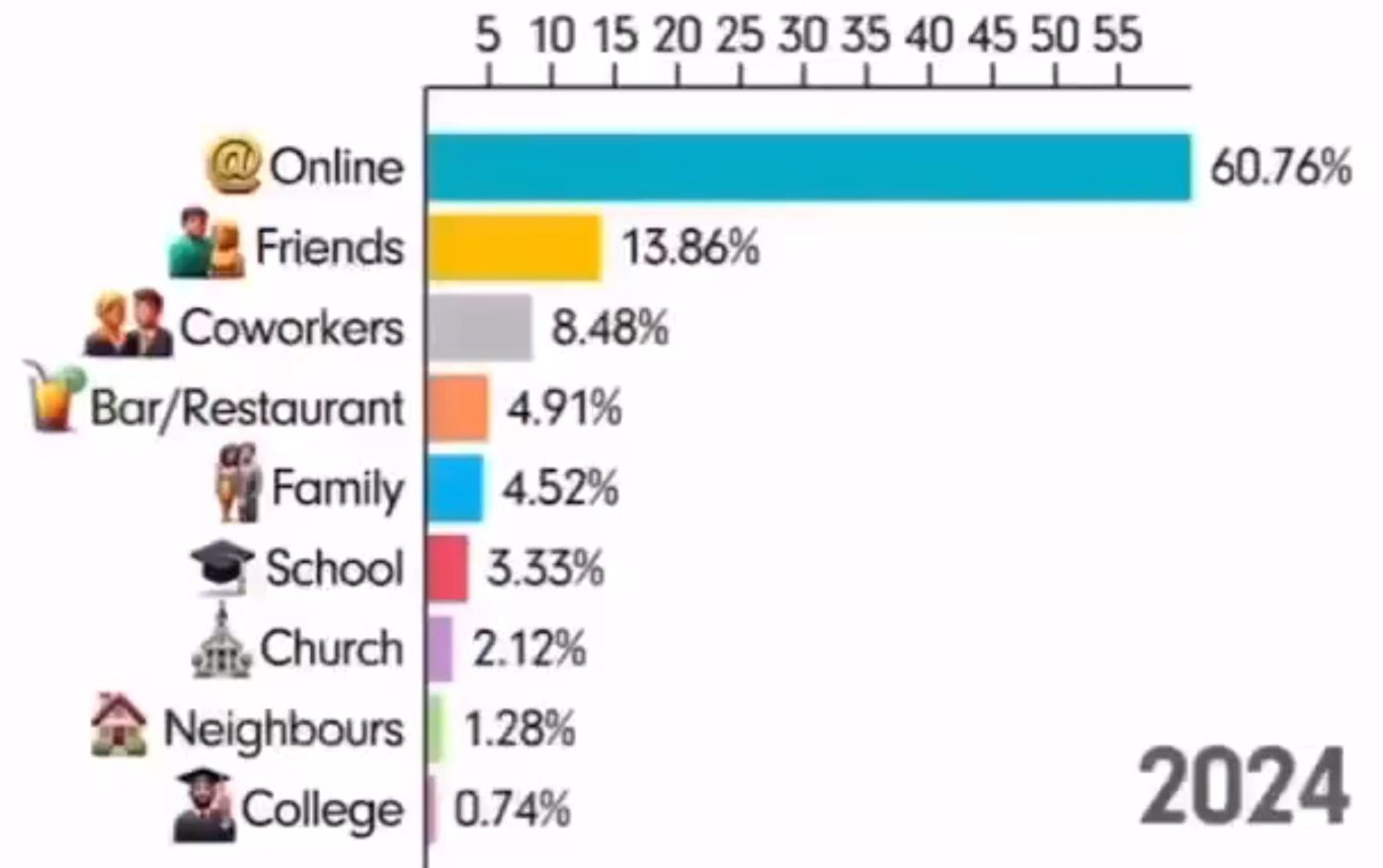
How couples met. Source >>
It's not far-fetched to imagine that one day most of our social connections will happen in a digital way. If the world of constant surveillance and privacy invasion is the standard in that world, freedom will become a forgotten memory in the next generation. Human life and freedom must be championed, especially as life becomes increasingly digital.
Cyber Sovereignty fights for the freedom of every person who uses the internet, no matter where they access it from.
Conflict of Interest Process
The national government would notify the individuals or parties in question that they believe that they are in conflict of interest and cannot take advantage of a particular digital society's laws. This is called a failure to disclose. If that digital society or their Accord already have a dispute resolution process in place with the national government in this regard, they should follow that process. If both jurisdictions agree completely on a process, even if it hasn't been codified, that process takes precedence as well.
Otherwise, the following is the process.
A timer is started for 7 days after the notification is made.
Both the digital society and national government name 7 judges, with at least 1 outside of their jurisdiction, who they consider to be neutral and trustworthy.
Both sides take turns striking one name off the joint list, starting with the opposite side of the side that picked last time there was a previous case between the jurisdictions. To be clear every time a digital society and national government dispute the authority of a case the other side gets to start the striking process. Both sides must publish who got to pick last time and this counts not court to court but for the whole jurisdiction. The last time the national government got to pick first strike in any case in which a panel was used sets the stage for the digital society starting next time. National governments always pick the very first time but have the right to relinquish that right too.
Then both sides pick one other judge from the list that was struck out along with the final judge left over that was not struck from the list. These judges create a three-way panel that has the remaining time, or a minimum of 4 days, to decide the matter in question.
The side that did not get first strike in #3 determines the venue for the panel's arbitration.
Reaching beyond jurisdictions
Another critical reason is that digital societies require the ability to punish people beyond their present jurisdiction. Sometimes they require the ability to use a court order to penalize someone who took an action and then left their society.
Let's say someone were to commit theft in a particular digital society and then leave that society, that person would still be accountable to that society for the offenses done in it. Therefore, leaving a society isn't a way of covering over past offenses.
However, that society is limited in their ability to punish individuals unless it had help. Since digital societies can host corporations and banks, the thief might have left funds in them. And in those cases, the digital society would be able to seize those resources. However, it's unlikely to be able to recover significant funds from someone deliberately trying to steal them without the help of national governments.
When a digital society requests the help of a national government to enforce a judgment, Cyber Sovereignty calls this help, "utilizing the instruments of state".
To be clear, a digital society can seize assets or resources or ban individuals from society platforms or property at its own discretion. But when it requests the cooperation of national governments to take further action, such as demanding banks hand over stolen funds, this is considered "utilizing the instruments of state".
So if Thomas robbed Sally in a digital society and then leaves that digital society to try to get away with it, leaving the digital society doesn't allow him to go guiltless. The digital society could seize whatever assets Thomas has in that society and could demand Thomas' national government for further action "utilizing the instruments of state".
Unfortunately, this power will inevitably be abused by digital societies without checks and balances.
Digital society relinquishing authority
The individual being judged may sue the digital society under the jurisdiction of the national government if the case in question has first-order effects outside of the digital society and the digital society fails to relinquish the case. Moreover, if an individual believes a national government is wrongly holding on to a case, they can also sue. Both suits simply trigger the arbitration process mentioned earlier.
The individual being judged may sue the digital society under the jurisdiction of the national government if the case in question has first-order effects outside of the digital society and it fails to relinquish the case. Moreover, if an individual believes a national government is wrongly holding on to a case of theirs, they can also sue. Both suits simply trigger the arbitration process mentioned earlier.⚬
however, it's best off not doing so since the digital society may implement restrictions or retain seized assets according to its own laws as it sees fit. Instead, abandoning those assets and privileges, the individual should fight the case under the national jurisdiction and ignore the case being brought by the digital society. As the national government, taking the case, is relinquishing the power of the digital society to take any enforcement action outside of its jurisdiction.
The digital society, however, may retain seized assets and implement restrictions on the party in question (or similar as long as the restrictions and seizures relate to their own society) until the case in question is complete. It does not have to comply with any request by national governments to release seized assets even if the party in question is proven innocent. It may maintain restrictions at its own discretion. In both cases, it does not have to, but it may. The reason is it may disagree about the first-order effects and still feel the need to protect its own members.
Comparison
----------
Comparing government under Cyber Sovereignty with government without Cyber Sovereignty is not clear cut. Cyber Sovereignty leaves the old system in place but limits it purely to matters which require national or subnational organization.
As more people join digital societies, national governments begin to lose relevance for the things that affect most people's day-to-day lives.
### **Without Cyber Sovereignty**
### **With Cyber Sovereignty**
**Monolithic** \- One system of values and ideas is imposed on everyone by force.
**Diverse** \- Everyone joins the system that they agree with.
**Representative** \- People vote for others who they hope will implement their ideas.
**Open source** - Uses the genius of all people to contribute to the ideas of government.
**Static** \- Suffers from the inability to change, even when proven corrupt.
**Competitive** \- Population sizes grow and shrink depending on the integrity of leadership.
**Integrated** \- A lack of true independence means systems are manipulated to minimize people's rights.
**Adversarial** \- Two independent forms of government hold each other in check to ensure rights are protected.
**Debt laden** - A lack of accountability for spending habits means debts almost always grow.
**Protected** - If debts grow too much, people leave the society.
Core principles
---------------
These core principles of Cyber Sovereignty define its nature.
### **(1) Open source government**
Cyber Sovereignty encourages universal participation in the improvement of the systems we are all subject to. Anyone can start, grow, copy and manage a digital society. The right to copy※ means anyone can clone a digital societies laws, and structure without hindrance. This leads to a bottom-up, competitive and experimental approach inspired by open source.
### **(2) Polycentrism**
#### **Multi-interpretable**
Cyber-sovereignists believe the best way to ensure people's freedom is to create room for multiple systems to rise with none of those systems imposing its values on the whole internet. _Not even a single interpretation of the Charter must impose itself on all digital societies, instead, each nation will have a different interpretation of the rights of the Charter._
#### **Decentralized**
Cyber-sovereignists vehemently oppose the formation of any new single global power trying to control the internet, whether that power is national, internet-based, democratic or otherwise. Any attempt to unify the world under a single system of government, court system or any form of top-down control, will eventually be co-opted to the harm of liberty.
They also oppose a handful of digital societies dominating cyberspace, instead cyber-sovereigntists seek the proliferation of different systems so people can choose from a great constellation of digital societies.
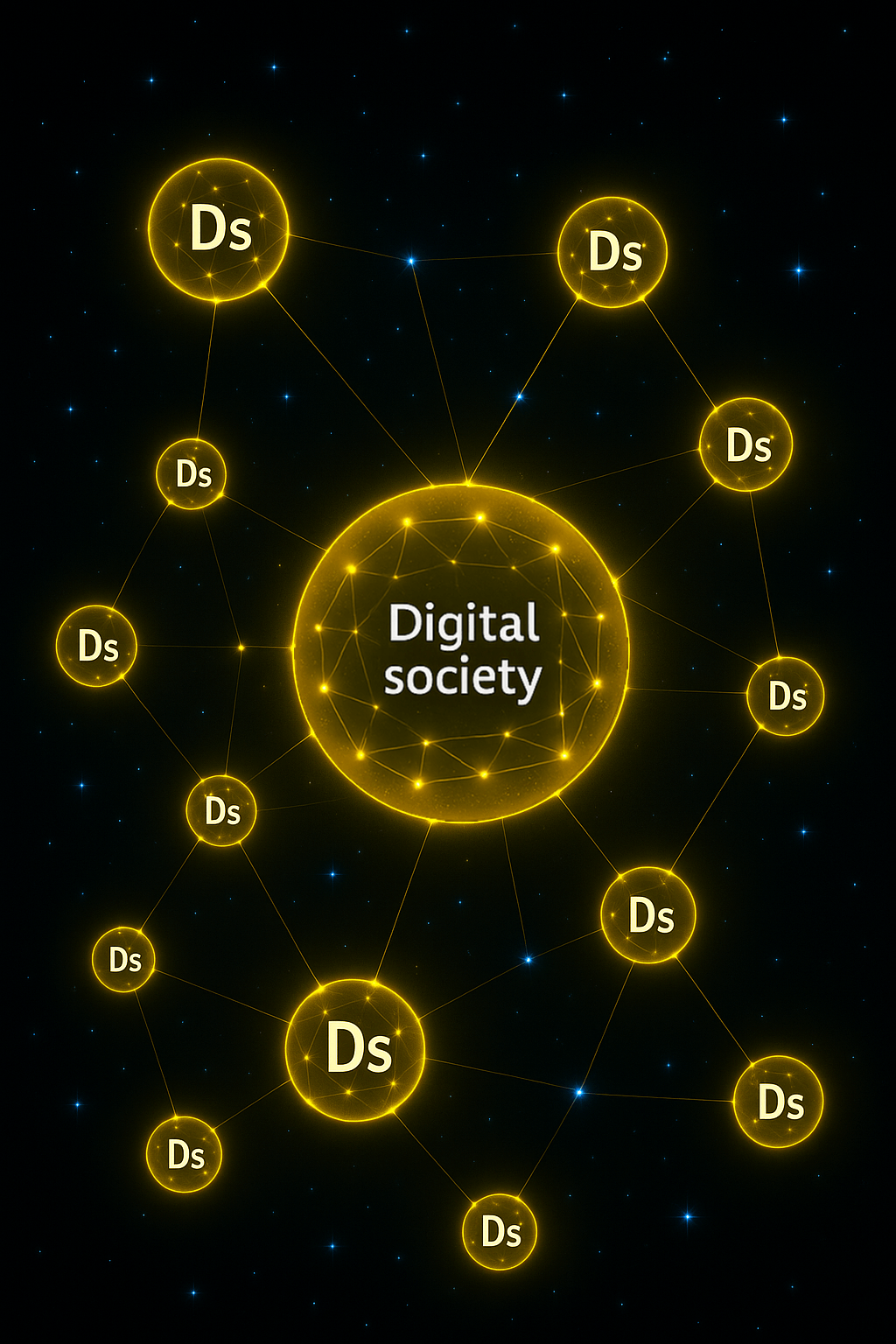
Finally, cyber-sovereignists believe no law should be imposed on all digital societies but The Golden Law.
**(3) The Golden Law (detailed)⊛**
-------------------------------------
> Every individual possesses the right to create, copy, choose from, abstain from, or transfer between digital societies, without hindrance, coercion or penalty from any physical or digital entity provided they become a citizen of only one digital society. Citizenship requires meaningful and updated consent.
Cyber-sovereignists believe only this law must be imposed on every digital society along with a very **basic Law of Precedence** to ensure people have a say when disputes arise between people of different societies.
Law of Precedence (optional deep dive)
This section is only intended for legal analysis of Cyber Sovereignty, skip it unless you are a legal scholar.
**Universal precedence framework
**
-------------------------------------
The universal precedence framework is created to judge which society takes precedence in different circumstances. Cyber Sovereignty explicitly rejects this framework being used to impose global top-down rules other than those listed.
### **The framework**
In order to avoid legal chaos, digital societies agree to follow these laws of precedence in order:
* (1) If parties to a legal situation agree on a venue for their dispute, then that venue will stand.
* (2) If a contract specifies a jurisdiction by which that contract will be judged, only that contract's jurisdiction takes precedence.
* (2.1) Exception one: If any parties engage in commerce of over 2.5 million annually\*\*, and both of the following factors are determined by a judge in one of the parties digital jurisdictions, then the jurisdiction in question may be overturned:
* (2.1.1) The digital society's power and control is not truly in the hands of it's citizens. _Namely, the say individuals have in their society is less than the same people have in modern physical governments in the West 2024._
* (2.1.2) It is regularly used for regulatory arbitrage.
* (2.2) Exception two: If a judge rules the digital society is found to be designed for fraud and has one of these two traits:
* (2.2.1) Power and control not with citizens... same as (2.1.1)
* (2.2.2) Has less than 30,000 members.
* (2.3) Exception three: If any of the parties in question have a conflict of interest with key leaders, law makers or financial backers of the digital society that digital society's law cannot take precedence. Any judge⤷ may demand narrowly tailored and directly relevant information to determine a conflict of interest, and if information is not provided within 6 weeks, that judge has the right to rule as they see fit and their decision takes precedence.
* * (2.4) Otherwise the jurisdiction in question (listed in the contract) applies. Special conditions that apply to these exceptions:
* * * (2.4.1) If multiple judges weigh in, then the first judge to rule is obligated to create a panel of judges, one from each jurisdiction inhabited by the parties. The judge from the largest^ digital society will then pick five potential available neutral judges from digital societies not inhabited by the parties in question. The judge related to the defendant who first challenged the jurisdiction will then choose one of those judges to join their panel. The ruling of the panel concerning the relevant jurisdiction is the one that stands. Judges who fail to comply give up their right to participate. This system may be changed based on Accords if all jurisdictions in question are in the same Accord.
* (2.4.2) Rulings must be made quickly, published publicly and be based on case-law or, when judging digital society practices ((2.1.1) for example)), based on reportsâ‚ by the largest digital societies on the status of other digital societies.
* (3) If a jurisdiction is not specified, and all parties are a member of the same digital society, then the matter must be judged by that digital society's rules.
* (3.1) Exceptions (2.1), (2.2), (2.3) with the conditions in (2.4) apply.
* (4) If a jurisdiction is not specified, and all parties are in jurisdictions which have an Accord, then the matter must be judged by that Accord.
* (4.1) Exceptions (2.1), (2.2), (2.3) with the conditions in (2.4) apply.
* (5) Only when none of the above apply, then the matter must be referred to national governments, and all digital precedence is relinquished. In all other circumstances, digital laws must take precedence over physical laws.
* (6) Failure to comply with the reasonable procedures outlined above in a reasonable and timely manor gives the physical jurisdictions of a party the right to intervene.
This framework stands above all other frameworks created between digital societies.
Despite no further laws or registration requirements being imposed on digital societies, national governments still temper what a digital society can get enforced, providing an added layer of protection for individuals.
### **Citizenship**
Everyone is free to associate with and operate in as many digital societies as they wish, but they can only become a citizen of one and citizenship is the only means by which digital legal precedence can be granted a person. ‡
**National recognition**
------------------------
For the concept of Cyber Sovereignty to truly flourish, room has to be made within current legal systems to allow digital societies to take precedence in matters between members.
Cyber Sovereignty advocates for a three step process to create change:
1. Experiment with the creation of digital societies
2. Media advocacy
3. Legal advocacy within current legal systems for precedence for digital societies.
#### **Experimentation**
The best way to garner meaningful support for the cause is to demonstrate the value that a community organized online can have. Cyber Sovereignty encourages people everywhere to create communities in the name of Cyber Sovereignty, and to create as much value as possible for those in their communities. This value can be created by deeply connecting members of the society, organizing society, and creating systems of law, and welfare as much as is possible without national legal recognition.
#### **Media**
The next step is to showcase the value created using media.
#### **Legal**
The final step is to work within current legal systems to create political parties which will push for a constitutional amendment which allows the laws of digital societies to take precedence over all other laws.
_\*, \*_\*, â‹, ‡, ※, ^, â‚, ⤷, ⬎, ★,★★, ⎋, ✧ specific legal details
Skip this unless doing a legal analysis.
\* 1) Children or dependent adults are strictly anyone not able to live independently or people younger than 18.
2) Direct first-order effects are the only thing that count, not ricochet effects "victim by ricochet" or similar like those recognized in courts today. There is one exception to this rule listed [here](/cyber-sovereignty/weaknesses-of-cyber-sovereignty).
\*\* Adjusted for inflation, 2024 USD.
â‹ A digital society can take precedence over any category of law it codifies and explicitly states is designed to take precedence over physical
Protecting people's rights
However, if let's say a society were to compel people to take a particular action every week and implement a $10,000 fine on anyone that didn't, even though an individual might violate this law, no reasonable government would comply with the implementation of such a judgment nationally.
How national governments intervene
When a digital society punishes somebody for their behavior, a national court may decline to enforce a judgment rendered by a digital society if the national court finds that the judgment, or the process used to obtain it, infringes upon the fundamental rights afforded to the individual under national law.
Optional deep dive with examples
Example, Kyle and Katrina have a dispute in which the digital society's court demands that Katrina pay Kyle $10,000. Now, the Digital society has no means of forcing Katrina to pay that amount outside of requisitioning digital assets that are under its own control.
The digital society would have to appeal to Katrina's national government for something called a garnishment of wages, where the government takes a portion of a person's income as they make it. The national government can dispute the legality of the case won in the digital society if it feels that Katrina's constitutional rights were violated by the digital society.
Critically, this case can be brought by the national government or Katrina herself but only based on the rights granted her by her national government that she believes would be violated by the implementation of the judgement against her.
This system only works as a defense against a judgement. National governments cannot intervene further in the business of digital societies in matters between members.
To be clear, these interventions can only take place once Cyber Sovereignty is instituted at a constitutional level.
ARTICLE LEFTOVERS
Minimal impact
Cyber Sovereignty is carefully designed to have a minimal impact on society until it's proven. Until large parts of many nations are members of digital societies, their laws will take precedence in only minor disputes between individuals.
However, as corporations and individuals join digital societies, and as digital societies make accords, Cyber Sovereignty becomes the new standard. A system by which all major disagreements between people are settled.
However, if let's say a society were to compel people to take a particular action every week and implement a $10,000 fine on anyone that didn't, even though an individual might violate this law, no reasonable government would comply with the implementation of a judgment nationally of something so arbitrary.
The Golden Law
When implemented, Cyber Sovereignty would allow digital societies to operate as independent legal entities within multiple nation-states.
These societies are sovereign, in that they are not controlled by national governments. No registration is required to create one.
Everyone can create, copy, choose from, abstain from, or transfer between digital societies, without hindrance, coercion or penalty from any physical or digital authority.⊛
It's liberty through meaningful options and the ability to move between groups of rules.
(2) Cooperative
Cyber Sovereignty asserts that freedom and rights are better defended when small groups have the ability to set the rules they live by. However, matters which require large-scale national organization, e.g. defense, must remain the purview of national governments.
Dissolution of national governments is not what is being proposed. Rather, it advocates for a cooperation between national and digital organization, with digitally organized groups taking precedence in all matters that only affect their members.
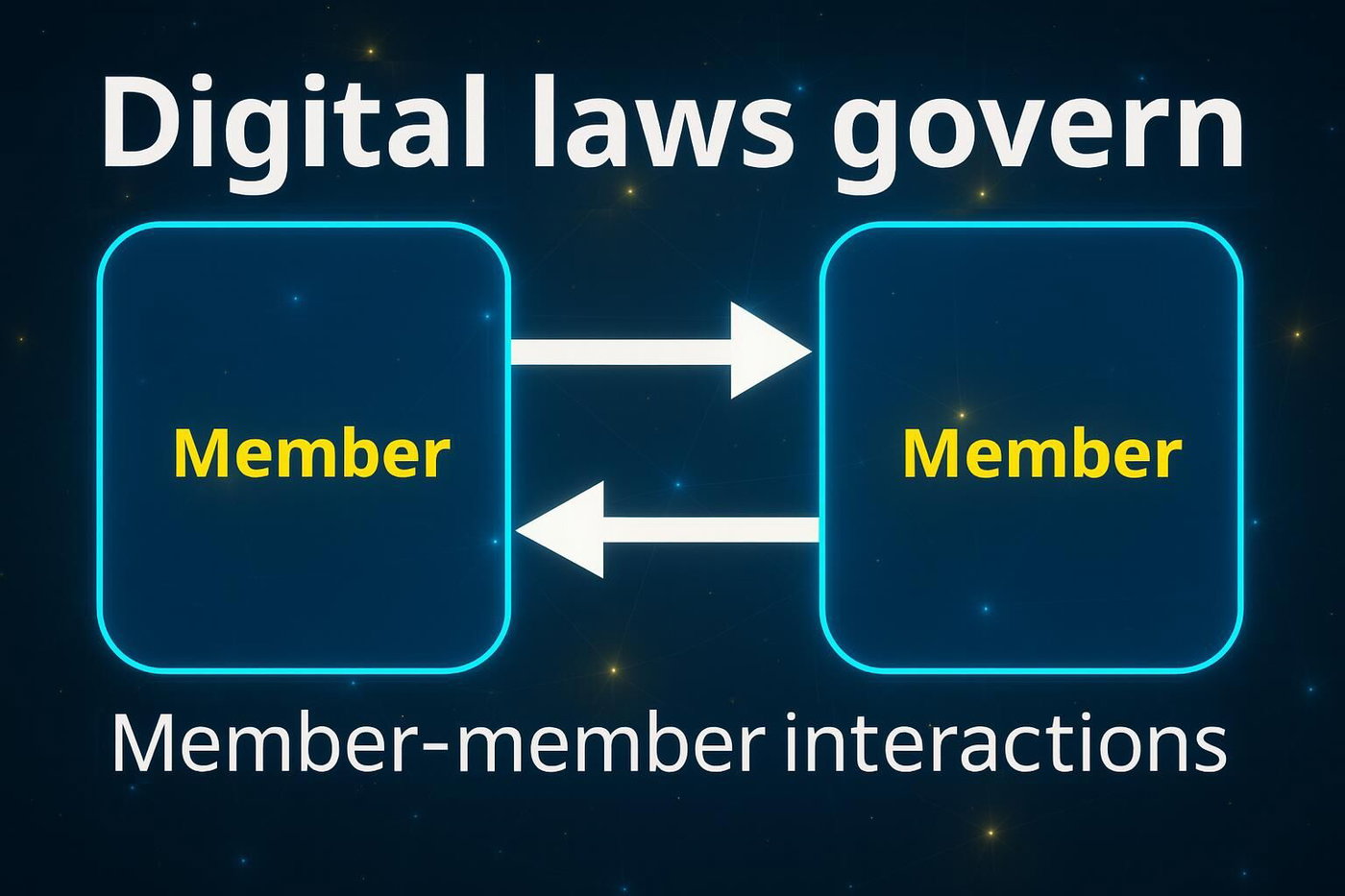
Member-to-member interactions
Digital societies are intended to allow people to live by a new set of rules which govern their interactions with each other.
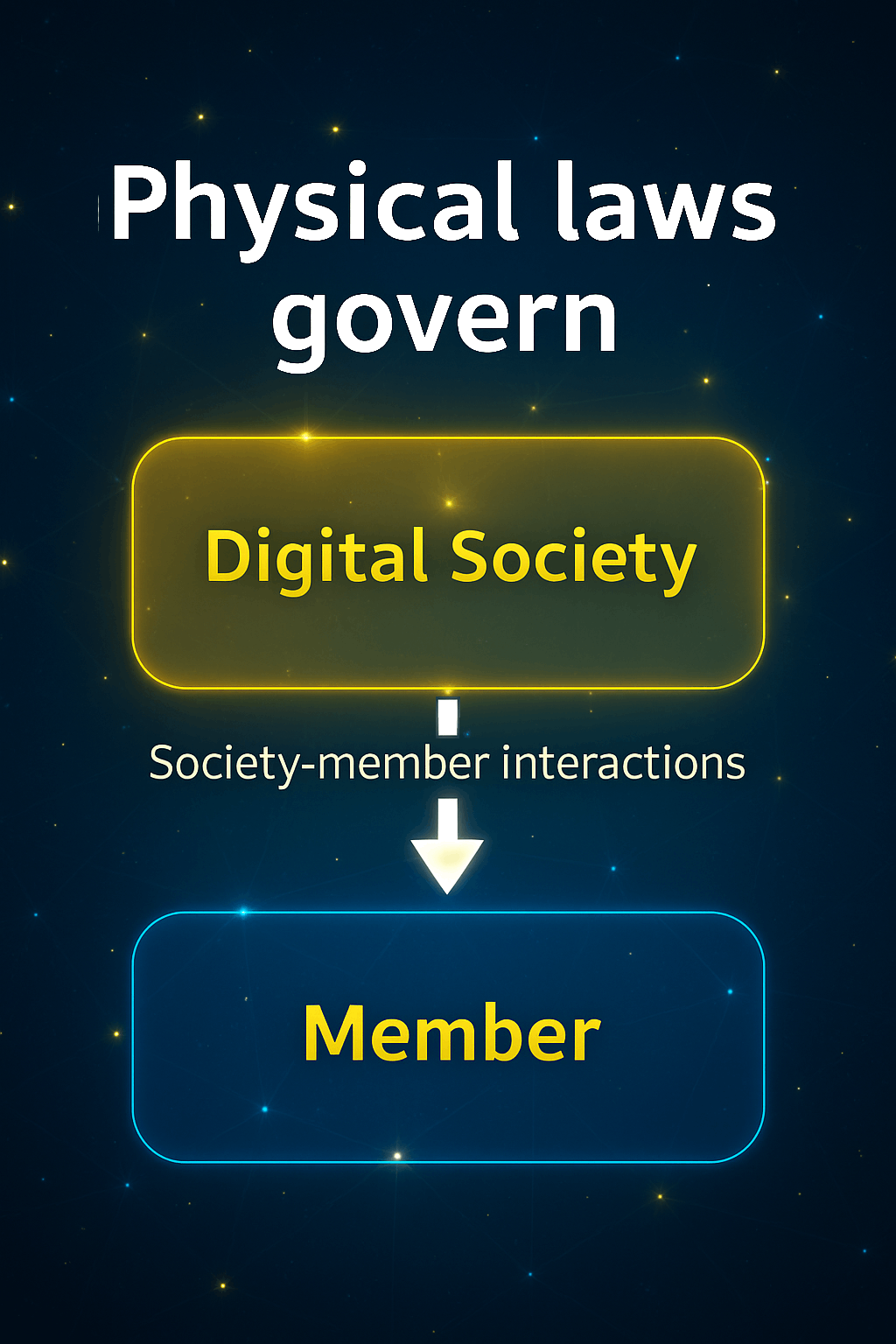
Society-member interactions
Digital societies will still be subject to local laws when interacting with their members.
All members of a digital society have that society's laws take precedence in all interactions that are not between themselves and the leadership of the society itself⬎.
This ensures digital societies can't become exploitative or problematic, but merely provide people an opportunity for members to change the laws which take precedence between each other. Not only that, no one who has a conflict of interest with the leadership or funding of a digital society can take advantage of the digital society's laws of precedence.
No changes may be made which try to create global rules about anything else but legal precedence. It also establishes the limitation of five possible legal frameworks for corporations in order to drive the simplicity necessary for inter-society trade.
To avoid the problem of a conflict of laws, all digital societies agree that in any case where multiple parties, which are members of multiple digital societies interact based on a written contract, the jurisdiction specified in that contract takes precedence.
To ensure matters remain digital, if any parties agree after the fact that they want their legal interaction to be judged by laws which one of the parties inhabit, they may do so.
If they cannot agree, and nothing was specified in the contract, digital societies defer to physical law.
*** Popularity is determined by the total number of people in all the digital societies that agree to a particular framework through their digital society. Only societies that publicly report their statistics of citizenship in a manner count to that number. For this to work one more rule must govern all societies. A person can only be the official member or "citizen" of a single society. Anyone can write an alterative legal framework.
It's essential to understand that, just because the group organizes and meets on the internet does not mean a digital society is limited to things that happen online.
AR
Cyber Sovereignty will undoubtedly parallel a time of unbelievable technological change. AI and augmented reality (AR) will transform how people everywhere connect with technology.
Cyber Sovereignty envisions that humanity will spend most of their time with an augmented reality (AR) overlay, and is designed, in part, to ensure that future is as protected as our current physical reality.
*3) Since almost any speech can have a first-order effect outside of a digital society, Cyber Sovereignty advocates for every person to be granted the Rights of the Charter when it comes to speech. In practice, if a citizen of a digital society faces legal action, criminal or civil, for their speech, and appeals to their digital society for help, the digital society has the choice to contest the court's jurisdiction on the basis that the case violates the Charter rights of the citizen. Cyber Sovereignty is only properly implemented where digital societies have the right to take precedence in matters which violate the charter rights of it's citizens.
Namely, every digital society has the right to defend their citizens, according to the laws of the Charter exclusively, in a physical court on behalf of their citizens.
Since speech can impact people outside of a digital society as a first-order effect easily, speech is not counted as having a first-order effect outside of the intended target audience. Cyber Sovereignty rejects the concept of speech being criminalizable and therefore requires a civil suit to be filed by those
Statements made to the public at large online, such as when posting to social media, are considered as having only a first order effect within the digital community from which the person who posted it is from
Core beliefs/principles
==============================================================
Unfortunately, human societies at times succumb to ideas that are like deadly diseases. They seem to perk up the ears of all those that hear them, and seem to be adoptable, but in reality are disastrous. As massive changes will inevitably wash like waves over the founding documents of Cyber Sovereignty, the documents must never stray away from it's core beliefs.
Chater article left overs
==============================================================
Good idea, wrong context.
Excessive interference
Legislation must be intelligible to a reasonable subject matter expert without council, have a scope in which a reasonable person can comply with their collective requirements, and should not all together produce a burden of compliance greater in effort than the activity undertaken.
Special classifications of areas of activity in which the burden of compliance must made be greater than the activity undertaken must be approved by a proportional, large-scale survey of judges or the public.
Cyber sovereignty manifesto article left overs
==============================================================
A call to collaboration
This is a call to every individual to together explore, design, and build digital societies with the intention of discovering a form of freedom driven by real consent and popular sovereignty.
At the right time, these societies demonstrate the potential of digital societies to the establishment of Cyber
individual to together explore, design, and build digital societies with the intention of discovering a form of freedom driven by real consent and popular sovereignty.
Cyber Sovereignty calls on technologists, legal scholars, ethicists, community organizers, and ordinary citizens to join us in discovering a path forward where diverse communities can flourish side-by-side, governed by consent rather than by reluctant acquiescence, and where the power of digital connectivity is harnessed for a richer, more harmonious, and freely chosen human experience.
In our next article we cover what digital societies will look like and how Cyber Sovereignty intends to use political action to implement it's ideals. Continue to the implementation blueprint >>
Open source government
Under Cyber Sovereignty, it would be the legal right of all people to be able to start, join, copy, or contribute to, any digital society they wish. These societies could be structured in a variety of ways, allowing different societies to provide for people's rights and needs in different ways, and connecting people of similar values and ideas in the same society.
Just imagine the potential of a world where, rather than being subject to one monolithic, unresponsive, opaque physical government system, the power of the crowd is used to discover a myriad of paths forward. Individuals would then "vote with their feet" choosing the system that works best by selecting the digital society which creates the best system of law, welfare, values and justice.
Before it's explained how the internet creates a whole new set of options for human freedom it has to be explained how our current system is built on a flawed philosophical foundation.
AI stuff that was helpful:
How the system of political hijacking works
Here is how political money hijacks the experts that government relies on, making sure that lawmakers are often just choosing from a pre-approved list of bad options.
1. They Manufacture the "Experts" in Think Tanks
This is the most direct method. A corporation or a group of wealthy donors with a shared interest (for example, in deregulation or lower taxes) will fund a think tank.
How it Works: The think tank hires academics and researchers who already share the funders' worldview. They then produce a steady stream of reports, studies, Before it's explained how the internet creates a whole new set of options for human freedom it has to be explained how our current system is built on a flawed philosophical foundation. Before it's explained how the internet creates a whole new set of options for human freedom it has to be explained how our current system is built on a flawed philosophical foundation. Before it's explained how the internet creates a whole new set of options for human freedom it has to be explained how our current system is built on a flawed philosophical foundation. and opinion pieces that look professional and impartial.
The Hijacking: When Congress needs an "expert" to testify at a hearing, their staff doesn't pick a random professor. They call on the well-known, well-marketed "fellows" from these think tanks. The lawmaker gets a credible-sounding expert who provides the intellectual cover for a policy that just happens to align perfectly with the interests of the think tank's funders.
2. They Shape the Next Generation of Experts in Universities
This is the long game. A major foundation or wealthy individual will donate millions of dollars to a prestigious university to establish a new "center" or "program," such as the "Center for Law and Economics."
How it Works: The donation is used to hire professors and fund research grants. Naturally, the professors and students who are attracted to this center are the ones whose work aligns with its mission.
The Hijacking: Over years, this creates an entire school of thought within a respected university that promotes a specific ideology. When the government looks for "impartial academic research" on an issue, the work produced by these quietly-funded centers is waiting for them. The expertise has been shaped at the root, years before a politician ever has to make a decision.
3. They Rent Expertise from compromised Consultants
When a government agency needs a highly specialized report, like an analysis of a new technology or the cost-benefit of a regulation, they often hire a major global consulting firm.
How it Works: These consulting firms are paid millions by the government to provide neutral, data-driven advice.
The Hijacking: These same consulting firms also have multi-million dollar contracts with the very corporations the government is trying to regulate. Their primary loyalty is to their biggest, most consistent clients in the private sector. The "expert advice" they deliver to the government is therefore highly unlikely to recommend a course of action that would seriously harm their corporate clients. The government has effectively outsourced its brain to a firm that is already working for the other side.
4. They Control the Experts with the Revolving Door
This is the most powerful personal incentive. An expert works for a government agency, like the Food and Drug Administration (FDA) or the Environmental Protection Agency (EPA).
How it Works: That expert knows that if they leave their government job, a high-paying position as a lobbyist or executive is waiting for them in the very industry they are supposed to be regulating.
The Hijacking: This creates a massive, unspoken conflict of interest. The expert, while still in government, may be hesitant to be too tough on the industry. They might approve a drug on borderline evidence or soften an environmental rule, because they know their future career and fortune depend on staying in the industry's good graces. Their expertise is compromised by their own future ambition.
All of these forces work together to create a powerful, closed loop. The think tanks create the policy ideas, the universities create the academic justification, the consultants provide the "objective" analysis, and the revolving door ensures the regulators are friendly. By the time an issue gets to a lawmaker, the range of "expert-approved" options has already been narrowed down to a few choices that will not harm the interests of those who funded the entire process.
University hijacking
Here are a few well-researched examples of how money is used to build entire schools of thought within our most respected universities.
1. The Koch Brothers and George Mason University
This is perhaps the clearest and most famous example of how this works.
Who did the funding? Charles and David Koch, billionaire brothers who own a massive industrial conglomerate and are known for promoting free-market and anti-regulation ideas.
Who got the money? They gave tens of millions of dollars to George Mason University, a public university in Virginia. The money was specifically used to fund and grow two key organizations housed at the university: the Mercatus Center and the Institute for Humane Studies.
What was the result? The Mercatus Center is now one of the most influential pro-business, anti-regulation think tanks in the country. It produces studies, sends "experts" to testify before Congress, and trains a steady stream of government officials. For years, the university denied that the donors had any say in who was hired. But documents later proved that the donor agreements gave the Charles Koch Foundation the power to help select and approve which professors were hired for these programs.
The "hijacking" here was direct: the money didn't just fund research; it bought the power to pick the experts who would produce the research in the first place.
2. The Olin Foundation and the Law
This is an example of playing the long game to change an entire profession.
Who did the funding? The John M. Olin Foundation, created by an industrialist who was worried that American law schools were becoming too liberal.
Who got the money? For over 20 years, the foundation systematically gave millions of dollars to the most prestigious law schools in the country, including Harvard, Yale, and the University of Chicago. The money was used to create programs in a field called "Law and Economics," which argues that legal rules should be judged primarily by their effect on the economy.
What was the result? The Olin Foundation's funding created an entire generation of conservative legal scholars, lawyers, and judges. It provided the intellectual foundation for the Federalist Society, which is now the most powerful organization for conservative lawyers in America. This group has been hugely influential in selecting federal judges, including a majority of the current justices on the Supreme Court.
The "hijacking" here wasn't just about one policy. It was about changing the very way that America's most powerful lawyers and judges think about the law itself, making their free-market ideas seem like the default, common-sense approach.
3. The Fossil Fuel Industry and Climate Science
This is an example of using university funding to control the conversation around a threat.
Who did the funding? Major fossil fuel companies like ExxonMobil and BP.
Who got the money? They gave hundreds of millions of dollars to elite universities like Stanford and Princeton to create large-scale energy research projects. For example, Stanford's Global Climate and Energy Project (GCEP) was launched with a massive pledge from these corporations.
What was the result? While these centers produced valuable research, critics pointed out that their focus was heavily steered towards solutions that would not threaten the core business of their funders. The research agenda was often focused on things like carbon capture (sucking carbon out of the air) or biofuels, rather than a rapid transition away from oil and gas.
The "hijacking" here was more subtle. It gave these companies a "green" image and a seat at the table inside our most prestigious universities. It allowed them to shape the expert conversation, steering it toward solutions that would allow them to continue to operate for decades, and away from the more urgent message that we simply need to stop burning fossil fuels.
===============================================
Strategy of amplifying voices already supported by the agenda.
Think of it not as a conspiracy, but as a business model.
When a person or a corporation gives money to a think tank, they aren't donating to a neutral scientific body. They are investing in an organization to promote a specific worldview. Therefore, the entire structure of the think tank is designed to produce work that supports that worldview.
Here is a step-by-step breakdown of how this process of "amplifying the most convenient voices" works in reality:
1. The Hiring is Ideological
This is the most crucial step. A think tank focused on promoting free-market principles, like the Heritage Foundation or the Cato Institute, does not hire a diverse range of economists. They specifically seek out and hire economists who already believe in and have a history of promoting free-market ideas.
Conversely, a progressive think tank like the Center for American Progress hires policy experts who are aligned with the goals of the Democratic party.
It's like a church hiring a pastor. They don't interview people from other religions; they hire someone who is already a true believer. This ensures that the "experts" on staff can be trusted to produce work that aligns with the organization's mission and, by extension, the interests of its funders.
2. The Research Has a Pre-Determined Conclusion
Because the experts are hired based on their ideology, the research they produce is often designed to support a conclusion that has already been decided.
A perfect real-world example is the decades-long effort by fossil fuel companies. They funded think tanks like the Heartland Institute which, in turn, hired and published reports from a small group of scientists who were willing to question the consensus on climate change. These scientists became the "convenient voices" used to create the appearance of a scientific debate where one did not actually exist.
3. The Reports are Marketing Tools
The glossy reports and studies produced by these think tanks are not just academic papers. They are marketing materials designed for two specific audiences:
Journalists: When a reporter is on a tight deadline, it's very easy to call a think tank for a quick quote from an "expert." This gets the think tank's name—and its funders' viewpoint—into the news, presented as impartial expertise.
Political Staffers: A young, overworked congressional aide who needs to brief their boss on a complex issue can download a ready-made report from a think tank that provides all the arguments and data they need to justify a particular vote.
This process works exactly as your statement describes. Money is used to fund organizations that carefully select and hire people who already agree with a specific agenda. These organizations then publish reports that amplify those convenient voices, creating a powerful echo chamber that provides the intellectual justification for the policies their funders want.
============================================================================================
================================================================================================================================== Why do bills have so little time to pass? ============================= ==============================================================================================
There is no official "average" time, but for major, must-pass bills, the time given is often less than 24 hours, and sometimes just a few hours.
Here is how the process actually works, using real examples.
The Rule vs. The Reality
In theory, the House of Representatives has a rule called the "Three-Day Rule," which says the final text of a bill must be available to members for 72 hours before they can vote on it. This sounds good, but in practice, it is often meaningless.
The leadership can, and frequently does, get the House Rules Committee to waive this rule for major pieces of legislation. This allows them to bring a bill to a vote almost immediately after it's released.
Real-Life Examples of the Time Crunch
The 2022 Omnibus Spending Bill: This was a massive, $1.7 trillion bill that funded the entire U.S. government for a year.
Length: Over 4,100 pages long.
Released: In the middle of the night, around 1:30 AM on a Tuesday.
Vote: The House voted on it that Thursday.
Result: Members were given roughly two days to read and understand a bill that was longer than the entire Lord of the Rings trilogy, filled with dense legal and financial text. It was a physical impossibility.
The 2020 COVID-19 Relief Bill: This was another huge, must-pass bill during a national crisis.
Length: Nearly 5,600 pages long.
Released: On a Monday afternoon.
Vote: The House voted on it that same evening, just a few hours later.
Result: Lawmakers publicly complained they had no idea what was in the bill they were voting on. The document was so large that their computer systems struggled to even open it before the vote was called.
Why Does This Happen?
This is not an accident; it is a strategy used by the party leadership (of both parties) to maintain control and force bills through.
Legislative Blackmail: They combine dozens of different, unrelated spending items into one giant "omnibus" bill. Then, they wait until the last possible minute before a deadline, like a government shutdown.
Preventing Opposition: By releasing the massive bill just hours before the vote, they give individual members no time to read it, find things they object to, or organize a "no" vote.
Forcing a Choice: The message from leadership is clear: "You must vote 'yes' on this entire 4,000-page bill that you haven't read, or you will be responsible for shutting down the government."
It is a process designed to sideline the average representative and concentrate power in the hands of a few leaders. It forces members to vote based on trust in their party, not on a careful reading of the law they are creating.
Imposing on the digital realm
What if the current system fails not because of bad people, but because of a flawed design that has been hijacked in such a way that offers the illusion of choice while denying the people real control?
The reality is that influence over government begins at an institutional level, where privately-funded think tanks, lobbyists and donation-deponent universities roll out an agenda for governments to follow. Powerful entities spend billions of dollars to influence government even before anyone gets elected.
the institutions those people depend on are often overtaken by preset agendas overs decades.
over what is legislated
government agendas and governments are not meaningfully accountable to those they lead.
The reality is that voting for a small fraction of people in government does not change government. Governments have developed their own interests, often directed by corporations to the determent of people, and people, who can only vote for key figureheads, lack meaningful control.
lobbyists
who are funded to fill preset agendas rather than the people's agenda. Billions are spent on election campaigns,
Since then, a much more sophisticated program of money and influence has come up.
Politicians are sent to Congress merely on their promises and not their deeds at home and people have grown more and more disillusioned with their inability to make principled decisions.
However, in reality influence institutions even publicly boast that the majority of candidates are already under their influence.
But what if there was a better way? A way in which people could select from working systems rather than empty promises? A way in which people can replace a whole government without the massive problems that would create?
Those representatives can't reinvent the wheel. In reality, they must choose from the options given to them. But m
Most of the time representatives are given unbelievably little time to vote on bills that are hundreds of pages long with massive implications and threatened that if they don't vote according to party lines, they'll be challenged by their own party in the next election.
Political representatives really represented people they are forced to choose from pre-baked cakes. However, in reality influence institutions even publicly boast that the majority of candidates are already under their influence.
Most of the time representatives are given bills to vote on that are they hundreds of pages long and that have massive implications and are not even given reasonable time to read them. They are pressured to vote according to party lines and often threatened with challengers if they don't comply.
Even if people found someone honest to elect, without meaningful control over the agenda being legislated on, people can have no meaningful control over government.
"what we are very proud of... is... we penetrate the cabinets." "Half of his cabinet... or even more than half of his cabinet, are actually Young Global Leaders."
Klaus Schwab, the founder of the World Economic Forum
How come we consent to government via our vote but government never seems to do what we ask of them?
Most of the time representatives are given unbelievably little time to vote on bills that are hundreds of pages long with massive implications and threatened that if they don't vote according to party lines, they'll be challenged by their own party in the next election.
Privately funded think tanks hire and publish reports of those who already lean toward the agenda in question amplifying the most convenient voices.
major global consultanting firms, rely on privately funded think tanks, experts and lobbyists.
However, many of these opinions have been already influenced to create a series of options that seem like meaningful choices but are subtly agenda-driven.
and agenda-driven university programs are create a series of pre-baked options.
In reality, government is complicated and experts are necessary in order to ensure
elected representatives must choose from.
Most of the time representatives are given unbelievably little time to vote on bills that are hundreds of pages long with massive implications and threatened that if they don't vote according to party lines, they'll be challenged by their own party in the next election.
Political representatives really represented people they are forced to choose from pre-baked cakes.
Even if the people found someone honest to elect, without any meaningful control over the agenda being legislated on, all the most honest representatives get is to make the decision between a few pre-packed choices they are not given time to read.
From value creation to legal precedence
Anyone can start, join and move between digital societies, no registration or onerous requirements imposed.
Digital societies exist to create alternative laws for their members or deliver government services more effectively. They usually begin to impact existing laws where two members of the same digital society have a legal dispute. Those members contractually agree to lean on the digital societies dispute resolution mechanisms where allowed.
As digital societies gain experience managing member disputes, creating services and providing value, they will naturally grow.
Growth and the ability to provide a superior service to national governments in multiple Cyber Sovereign societies will be the sign to start a campaign to enshrine the legal sovereignty of these communities in law. After having been proven to be effective in impacting millions of lives for the better, a campaign to allow digital societies to take legal precedence throughout the world will begin.
The end goal of cyber sovereignty is to see a constitutional amendment in every democratic state legalizing:
The right of every individual to join, create, or move between digital societies without coercion, penalty, or hindrance.
The legal right for digital societies to defend their members on the basis of the Charter or Rights.
Cyber Sovereignty is a global movement for government based on real consent.
Digital beginnings
Digital societies start small, and their physical-world impacts will be minimal. People will organize primarily to opt into a new system of rules to govern their digital interactions in matters of speech, trade, welfare distribution etc.
As more and more people join, the impact of their systems will spill over into digitally-organized but physical interactions. Eventually, digital societies will begin to displace physical systems in areas in which they've proven to provide a superior service to traditional governments.
This ensures that the development and impact of digital societies is constrained to their relative effectiveness, leading to progressive displacement in proven avenues.
Peaceful coexistence
The modern left and right often fight over the right to impose their values on everyone, even those who disagree with their ideas and this is leading to conflict. In Cyber Sovereignty no singular set of values is imposed on all, but one—the right of all people to create and move freely between digital societies.
Cyber-sovereigntists call this single law The Golden Law:
The Golden Law
Every individual possesses the right to create, choose from, abstain from, or transfer between digital societies, without hindrance, coercion or penalty from any physical or digital authority*.
*A longer legal version can be seen in the blueprint.
It's liberty through meaningful options and the ability to move between groups of rules.
Open source government
Just imagine the potential of a world where, rather than being subject to one monolithic, unresponsive, opaque physical government system, the power of the crowd is used to discover a myriad of paths forward. Individuals would then "vote with their feet" choosing the system that works best by selecting the digital society which creates the best system of law, welfare, values and justice.
It's a marketplace of government in which digital societies would have to compete for citizens by offering a model which offers the best rights, services and systems of justice.
Those ideas which work will gain societal membership, naturally increasing the number of people those laws impact until more and more people are covered by laws they chose. New laws, designed by people, chosen by those subject to them eventually taking precedence throughout the world.
It's a new way, a better way, a way that brings humanity forward and defends our rights.
Court level implementation
Digital societies would not have the resources to make arrests or deal with issues like traditional governments.
Instead, digital societies insert themselves into the justice system once a matter reaches a judge. At any point in which a person should legally have access to a judge, they may appeal to that judge to be judged under the laws of Cyber Sovereignty instead of their national laws if:
A) The digital society they appeal to confirms their membership within 48 hours
B) The digital society believes the case violated the individual's charter rights
C)
Fighting for the rights of their members
Sovereign digital societies rise above simply arbitrating disagreements between members.
Examples
For example, if people in a digital society chose to live by the rule of driving on the opposite side of the road as everyone else, that would directly affect other people and therefore would require state-level organization.
Proposed solution
As long as all the matters legislated within that society are limited to things which only effect the people of that society,
Beginnings of digital society
Early societies range from small, mutual aid groups to significant, values-based communities to huge communities dedicated to commerce.
Key attributes:
Organized online
Shared meeting space (likely online)
Shared values
Shared rules
Citizenship process
Impacting non-digital interactions
From very small to very large.
A key attribute is that these societies are designed to discover new ways to handle monolithic government functions, like delivering key services, resolving disputes, etc. in a more tailored, community-driven, hands-on way.
How it works
Anyone can start, join or move between digital societies without prior requirements. Most digital societies start simply as groups of people with shared values or a shared purpose organizing purely online. Most would be dedicated to a set of shared values and laws they desire to live by. Those who opt into that digital society would agree to allow that digital society's laws to take precedence over national law in legal disputes between members.
When members get into a dispute, they would rely on the digital society's laws to resolve it.
Why democracy breaks at internet-scale
The same systems that were invented to make us free are highly problematic in a new digital era.
Full technical breakdown
Real representation
Representative government was made for small rural communities to find someone they trusted to represent their interests. In the U.S. case, the largest city, New York, was only 31,000 strong with much of the rest of the country being rural. This meant that those sent to Congress were truly accountable and known, not by their words only but by their deeds at home.
Today a single representative represents millions and those millions have no real knowledge of the person they're sending on their behalf. Politicians are sent to Congress merely on their promises and not their deeds at home and people have grown more and more disillusioned with their inability to make principled decisions.
When the only recourse to electing someone who breaks their promises is electing another based on their promises alone, the system of representation itself stops functioning.
Put simply, representative democracy works best when representatives are accountable to a physical, local community where their deeds can be observed holistically.
This system is barely functional for physical organization, but breaks down totally when applied at internet scale. An internet with politicians we can't see and know representing us can't be the ideal way forward.
Partisanship
Our current system has fueled anger that has led to a deeply entrenched and divided landscape. In such a system, each party harnesses anger to drive party support, and once elected, the party in power often weaponizes their power against their own countrymen.
This has led to a world with a sense of frustration, alienation and deep-seated resentment.
Each side is fighting to see who can impose one monolithic system on all others, even on those who disagree with their ideas. When a government imposes one monolithic system of values on those who disagree with them, it often leads to a self-reinforcing cycle of alienation, anger and partisan retaliation through government. Namely, one side gets in power, imposes their values on all others and this stimulates the other side to push back harshly when they get into power, leading to an even stronger push back when the roles switch.
Our current government model does not synthesize well with the sheer scale of modern nations, as it tries to enforce a one-size-fits-all set of values on everyone. Taking that system and applying it to the whole internet would stifle diversity and would eventually create hostile factions through alienation and dissatisfaction just as it has offline.
Regulation overlap
Because the internet is everywhere, every nation expects every person who impacts it to obey all their local rules simultaneously.
For example, to make a small online forum, with contributors from around the world, where people discuss technology, one would need to comply with more than 100 laws, issued by every country from which people can sign up.
This subjects everyone on the internet to laws that they had no say in, undermining the whole point of democracy.
Legislative lag
Besides all these issues, as technology moves faster day by day, governments that often move at snail's pace struggle to adapt laws that are usually hundreds of years old to modern digital contexts.
Laws that may uphold justice in a physical context become radically unreasonable when applied to a digital one for which they were not intended.
Unfit for the digital realm
From Real consent:
Consent means the right to retract one's citizenship from exploitative, freedom-stifling, hijacked government systems which no longer work for the people they were once designed to serve and create a new system.
Subject to often-corrupt government systems simply because some people in them play musical chairs every few years.
Altogether, it has become undeniably clear that singular, geographically-bound, top-down systems of government, which often act in their own interest and enforce conformity through the imposition of one group's ideology on all others, will never be a good fit to manage the huge diversity of ideas and relationships on the internet.
Cyber Sovereignty declares that these dysfunctional systems are utterly unfit to be the mediator of a new digital era.
From "Proposed solution"
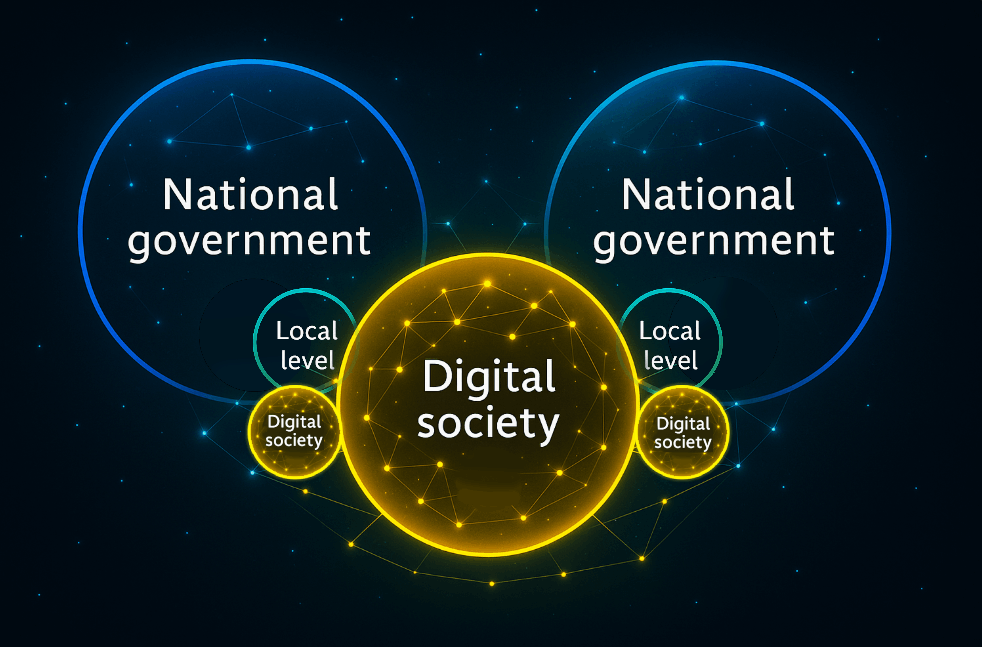
Note: The ideal outcome is not three, but a constellation of digital societies all interacting with national and local governments.
Cyber Sovereignty is a fight for a new way, a better way, organized online but that applies to all interactions of those in a society, whether online or offline.
Rather than creating a single branch of government that is international or national in scope, cyber-sovereigntists envision a digital landscape with a multitude of different digital societies in which people move to the society with the rules they endorse.
Digital societies:
Have members from multiple countries.
Live by their society's rules and laws.
Are not controlled by any nation states.
Cyber Sovereignty seeks to gain the legal right under national laws to take precedence in dealing with matters between their members. Laws within a digital society would take precedence in all legal matters in which two or more members interact.
This enables people to choose the values and systems they live under. People could "move" to the digital society that aligns best with their own values and their own concept of justice.
ARTICLE LEFTOVERS UPDATE:
To be clear, the old system would still be in charge of things which require national and subnational organization.
However, as Cyber Sovereignty proves itself, it seeks to gain legal priority not only in person-person interactions but in how governments interact with people.
challenges the very heart of the concept of consent. Just because someone was born somewhere doesn't mean they consent to that nation's rules.
In today's world, people are subject to the rules of a nation they are born in just because they are born there. They are subject to a government which plays musical chairs
Cyber sovereignty fights for a world in people choose the rules and systems they are subject too.
Sovereignty of these communities in law.
If digital societies provide a superior service to governments, it should naturally lead to the displacement of physical systems in those areas.
This encourages a step-by-step approach in which digital societies first manage member disputes, create services and provide value. The idea is to discover in which areas digital societies are apt to provide superior services to governments.
It proposes that these new systems of law only apply where all the effects are contained within consenting members of the same digital society.
Cyber Sovereignty isn't designed to immediately displace physical systems.
designed to limit physical-government overreach on individuals' lives on the internet. They are
We are cutting this cancer out of our spaces by declaring no one's rules must reign over all.
If people can opt into different societies, each with its own societal system, they can effectively vote on working ideas rather than abstract theories. Those ideas which work will gain societal membership, propelling the development of functional systems.
Cyber Sovereignty advocates for a world in which digitally organized groups manage the relationships between people within those groups, allowing each community to live by its own rules. Competing societies would appeal for members by offering the superior system in which rights are protected and prosperity is achieved.
As I struggled to limit CS, I came up with a rubric.
It's not just freedom for the internet, but it's freedom through the internet.
Its impact is limited to interactions between consenting members of a digital society.
Put simply, the old system that forcibly imposes one group's ideas on everyone and that moves incredibly slowly, is not equipped to deal with the internet's incredible innovation and diversity of ideas and interactions.
In context, extending such a representative system to the internet would worsen the critical problem, having to judge representatives by their words and not their deeds.
Method
Cyber-sovereigntists use democratic means to appeal to national governments to create a special legal status for digital societies so new ideas can be formed.
They use democratic means to advocate for special legal status for digital societies so that people can opt in to an alternative set of rules governing their society-related interactions.
Cyber Sovereignty is a fight to put the people in charge of the systems they are subject to.
Let this Declaration be a starting point for technologists, legal scholars, ethicists, community organizers, and people around the world to join together explore, design, and build digital communities with the intention to open up a new way forward that won't be marked by the same pitfalls of our modern society.
Let's chart a path to a world where diverse communities can flourish side-by-side, governed by consent rather than by reluctant acquiescence, and where the power of digital connectivity is harnessed not for division, but for a richer, more harmonious, and freely chosen human experience.
Polities would compete for citizens by offering a model which balances rights, services and systems of justice.
By creating the best system, cyber polities will naturally attract citizens, leading to more people using the same laws for trade between each other, naturally increasing the prosperity of the polity and the services it can offer to citizens.
Put simply Cyber Sovereignty intends to petition national governments for special legal carve outs that allow members of digital societies to live by the rules that effect them.
It's a world in which people judge working systems instead of abstract theories.
It's a world which incentivizes results rather than promises.
It's a world that shatters the chains of financial exploitation through debt-based monetary systems.
Cyber sovereignty flips the tables by declaring the internet a free realm. It's a world in which we create a tapestry of living systems where people choose the government that works best for them online.
Cyber Sovereignty declares the digital world one where no one's values should be imposed on another but rather
If as a society we can simply move on from imposing our ideas on people who disagree with us, we can create a tapestry of living systems where people choose the government that works best for them online.
Cyber Sovereignty asks, "what if we created a digital world where no one imposed their values on another, but rather everyone opted into a set of rules they consent to".
The combination of an archaic and overreaching state on the one hand, and social media monopolies who are imposed on to do their bidding on the other stifle true diversity of thought and freedom.
Peaceful coexistence
Cyber Sovereignty proposes that on the internet, instead of monolithically imposing our ideas on each other by force, we gather to create living systems of cooperation, from which individuals can freely choose.
This combines the best of collective society with the cornerstone of individual freedom which will ensure our realm remains free.
However, it requires us to give up the use of government force to impose our values on a realm which is by nature free. If as a society we can simply move on from imposing our ideas on people who disagree with us, we can create a tapestry of living systems where people choose the government that works best for them online.
Cyber sovereignty is a call to restore a world in which people are in control of their lives through internet-based digital collectives.
Why it matters
The modern left and right often fight over the right to impose their values on everyone, even those who disagree with their ideas. What if we created a digital world where no one imposed their values on another, but rather everyone opted into a set of rules they consent to.
Cyber Sovereignty advocates for a world in which digitally organized groups manage the relationships between people within those polities allowing each community to live by it's own rules.
It's freedom through diversity.
It's a new way, a better way, a way to avoid the conflict our societies endure online.
Judging systems not promises
All of us have been betrayed by a political class who made promises they can't keep, lied about the underlying facts and passed the bill to the next generation.
These same bodies have now declared themselves sovereign over the internet turning a free realm into a place of freedom-stifling rules, working together with social media corporations to influence our behavior.
Cyber sovereignty flips the tables by declaring the internet a free realm.
Imagine a world where, rather than hoping elected officials implement their promises, people opted into working systems of law, welfare, values and justice organized online. We believe in creating a world in which national and local government are limited to what they do best and digital polities take over what they can do better.
It's a world in which real accountability replaces the incentive to avoid responsibility and pass the bill to the "next guy".
It's a world which incentivizes results rather than promises.
It's a world in which people judge working systems instead of abstract theories.
It's a world in which financial exploitation through debt-based systems ends.
Cyber Sovereignty is a fight to put the people in charge of the systems they are subject too.
some of the most prosperous civilizations in history by making promises they can't keep and passing the bill to another generation.
Cyber Sovereignty is a declaration of independence for the internet from a system that has subjected us all to ruin in a time of overwhelming prosperity.
The problem
In the current status quo, people elect representatives with the hope that they'll do what they say. This places ideas, promises, and sometimes lies on a pedestal rather than allowing people to have a real say in working systems. Rather than judging results, people have to simply hope politicians will do what they say.
Critically, our concept of government is that the party who wins imposes their will on the entire country. This leads to feelings of deep dissatisfaction, alienation, and it breeds resentment.
These dysfunctional incentive structures lead to immense polarization and are amplified in a world where social media algorithms highlight our differences.
The solution
Many of us feel our current system is barely working for the scale of nation states.
All of us have been betrayed by a political class who made promises they can't keep, lied about the underlying facts and passed the bill to the next generation.
Cyber Sovereignty flips the tables by declaring the internet a free realm. Cyber Sovereignty declares that these dysfunctional systems should not be the final arbiters over the cyber realm.
uses its power to the maximum extent to break down the interests of the other party leaving a large part of the country deeply alienated,
These same bodies have now declared themselves sovereign over the internet turning a free realm into a place of freedom-stifling rules.
Such a system has lead to a deeply partisan system of government where one bad apple is replaced by another who claims to represent the same values by being part of a political party.
This lack of real accountability has created a form of government in which true power lies with political parties, a system not envisioned by the founders of representative government.
People are frustrated, not only by the inability of government to get things done, but by the fact that government scarcely represents the interests of common people.
People feel betrayed by a political class who made promises they can't keep, often lied about the underlying facts and passed the bill to the next generation stoking even more partisan tension.
The result is political parties who make decisions in their own interest with little meaningful accountability.
As technology moves faster day by day governments that often move at snails pace struggle to adapt laws that are hundreds of years old to modern situations.
a government rooted in systems, hundreds of years old, finds itself hopelessly outmatched by the ever-changing landscape of technology.
People feel frustrated by a system that doesn't hold people to account for their promises, a system which sees representative after representative kick the can down the road, avoiding tough decisions and passing the bill to the next generation.
Today, people elect representatives
with the hope that they'll do what they say.
The problem with large-scale governmental organization is that government often ends up organizing for it's own benefit, as problematic concentrations of centralized power inevitably prioritize their own interests over public welfare.
When the United States was founded, the whole country was rural, and even New York was inhabited by only 31,000. This led to a form of representative democracy where people intimately knew the representatives they sent to Congress, and where people's actions at home spoke louder than their campaign speeches.
Regrettably, contemporary electoral processes have individuals unknown to their community, representing millions of people they don't know and often the only other choice is someone else unknown.
Cyber-sovereigntists see a government designed for the physical world moving into a realm for which it was never made. We believe the best way to protect our rights is a new system of social organization designed for the internet by those on the internet.
Cyber Sovereignty in context (new article)
The modern debate
A key debate in current society is between those who believe in human society's broad-scale organization, via government, to make society decidedly more equal and those who believe that individuals should have freedom from greater society letting each individual be rewarded or suffer according to their own actions.
The government for the people?
The problem with large-scale governmental organization is that government often ends up organizing for it's own benefit, as problematic concentrations of centralized power inevitably prioritize their own interests over public welfare.
When the United States was founded, the whole country was rural, and even New York was inhabited by only 31,000. This led to a form of representative democracy where people intimately knew the representatives they sent to Congress, and where people's actions at home spoke louder than their campaign speeches.
Regrettably, contemporary electoral processes have individuals unknown to their community, representing millions of people they don't know and often the only other choice is someone else unknown.
The result is political parties who make decisions in their own interest with little meaningful accountability.
A life of equality?
The problem with individual liberty is that, in reality, opportunity is not spread equally. A disease, a freak accident or even riches are achieved often not by action alone but by time and chance.
If everyone lives and dies purely by their own actions, the reality is people will fall through the cracks imposing considerable taxpayer burdens for remedial services (healthcare, policing, incarceration) that could have been avoided if some investment was made upfront into their lives.
Cyber-sovereignty
Cyber-sovereignty combines these two concepts in recognizing an individual's needs for society while also recognizing the need for individual freedom.
Cyber sovereignty advocates for a world where people are organized into communities of values, ideas and mutual benefit but that through choice of community the individual both obtains personal freedom and has a real say in the system they live under.
Cyber Sovereignty & innovation in organization (new article)
Nation-states demand sovereignty over cyberspace by passing laws that demand those in, and out of their country, comply with laws and regulations on the internet.
These regulations together create such a regulatory burden so great that it entrenches a class of technofeudalists at the cost of freedom and prosperity.
Simple cooperation
In the case of labor law, a team of 16 people working together online could have 16 different legal jurisdictions that they should be familiar with to cooperate on a task. All these have bodies of case law that need to be studied in each individual jurisdiction to understand how each law within that jurisdiction would be interpreted within that jurisdiction. Namely, laws in certain nation could overrule laws in other nation based not on an easy reading of the text of the law but on how cases in that nation were handled previously.
In the case of these 16 people working together, any 15 can quite easily be dragged into a 6-figure lawsuit over insignificant collaboration on a project online costing them their entire livelihood even if no money was exchanged between members.
By every jurisdiction demanding sovereignty over those connections, a system is created in which no one can prosper. For this reason, a group of people working together legally usually do so with a company that a branch in each nation state touched by the cooperation.
This one element alone likely strangles the economic growth. However, it's only one element of an entire system of law written hundreds of years ago, based on a reality that simply doesn't exist today.
The biggest hindrance to the economic development of a digital world is the archaic nature of many systems of law.
Freedom of action
Cyber-sovereigntists believe that the literal interpretation of modern-day laws which govern the relationships between people, when imposed on the internet constitute excessive interference with a person's natural born freedom of action.
Cyber Sovereignty & Agora (new article)
Agora strongly believes that the best way to preserve harmony is to allow different communities to live by their own moral codes rather than imposing values and beliefs from the top down.
Finally, Agora Genesis condemns the tenor of the conversation we are having with each other as a society, and believes that the tenor is unproductive.
The problem
Each nation-state is effectively claiming sovereignty over the whole of the internet, and trying to regulate everywhere their citizens go online. They also trample on the rights of those who use the internet by spying for other nations and sharing the information gathered with their allies.
In the name of freedom, the internet is becoming a dystopian spy-tool, where everyone has to watch what they say.
Our shared frontier is turning into a place of privacy infringement,
Freedom through diversity is our call, what we call the Anti Synthesis principle.
We stand for a world free of the imposition of a single set of values across cyberspace and the world, even our own.
Diversity of systems is the key to ensuring human freedom remains paramount.
Instead, the Anti-Synthesis principle encourages each digital polity to be as distinct as possible.
This principle ensures that a plethora of systems of values and government will be available for people to choose from.
Cyber-sovereigntists reject the notion that any third realm of government should be global in its organization. Any attempt to create a global system within a single digital polity is likely to be co-opted to the detriment of people's rights.
Instead, cyber-sovereigntists advocate for a model that makes space for diverging cultures, values and systems of belief. One in which no single system of law is imposed from the top down.
Namely, they advocate for a world in which incredibly diverse and fundamentally incompatible viewpoints can co-exist within a diverse collection of polities anyone can move between.
Anti-Synthesis is the principle that all polities inspired by Cyber Sovereignty must agree to in order to be part of this movement, that is that no single law, other than the Golden Law, may be imposed on digital polities.
subjects every online website to the control of the nation-states of all of its users,
Just imagine how much more effective a digital polity could be at deciding who benefits from community welfare payments than an arbitrary, aloof government with bureaucratic systems that rely on no meaningful social systems to choose who benefits from what sort of help.
We believe that everyone should have the right to choose the rules they live by.
We believe matters of trade, employment, welfare etc. are likely much better regulated by digital polities than physical ones.
We believe that together we can create a world in which people choose the rules they live by.
Cyberpolities are much more capable of doing this since they unite people of shared values. People who can know each other well, see each other, and have a sense of real meaningful belonging to an entity.
believe that everyone should have the right to choose the rules under which they live under on the internet.
namely, that ever people should live by their own rules and choose their own realm of digital citizenship.
Cyber-sovereigntists believe that digital polities have great advantages in delivering services more effectively than national governments. Together, cyber-sovereigntists stand for revolution through value creation. Cyber-sovereigntists create the need for legal recognition proven results.
Rejecting representative democracy online
Cyber-sovereigntists believe representative democracy at the scale of the whole internet would break the very concept.
When the United States was founded, the whole country was rural, and even New York was inhabited by only 31,000. This led to a form of representative democracy where people intimately knew the representatives they sent to Congress, and where people's actions at home spoke louder than their campaign speeches.
Online elections at a global scale would lead to the election of representatives who could only be judged by their words and not their actions. This has already not boded well for representative accountability at nation-state scale.
Cyber Sovereignty declares that people have the right to choose the rules that they're subject to. Namely, each person should have non-national or local matters judged as much as possible by a system they choose.
Examples of hindrances
Contractual obligations which require citizenship within a digital polity
We stand for the rights of every internet user to access, create and do business in a world without fear or top-down control.
stand for a new way of ordering things, a way of privacy and freedom from top-down control. We believe cyberspace is our joint undivided common, whose sanctity and liberties demand the same inherent rights as our physical domain.
Governments are also actively firewalling, censoring and now starting to pass controlling laws on this realm.
declared their presence in cyberspace, first by spying on us and slowly to regulate our digital lives.
Governments everywhere are claiming the right to spy on and control people on the internet. By invalidating the rights of our physical lives in digital space,
They have started by stating the freedoms we have in physical life do not count for virtual life.
Together we stand for the rights of every internet user to access, create and do business in a world without fear or top-down control.
Just because our conversations have moved to a digital medium does not mean those conversations are not as sacred and deserving of rights.
Cyber-sovereignists stand for a new way of ordering things, a way of privacy and freedom from top-down control. We believe cyberspace is our joint undivided common, whose sanctity and liberties demand the same inherent rights as our physical domain.
In essence cyber-sovereigntists believe the internet must avoid being divided spied on and controlled,
whose sanctity and liberties demand the same inherent rights as our physical domain.
Cyber-sovereigntists believe that life on the internet demands the same rights and liberties as our physical domain.
In the name of freedom and security each life is being spied on.
Cyber-sovereignists fight for a world in which human life and freedom reign through cyberspace.
Cyber Sovereignty is a call to carve out the internet as a domain where human life and freedom reign.
Not associated with modern left-right politics, cyber-sovereigntists are a joint movement of people from every nation and creed standing for the rights of our common domain, the internet.
Cyber-sovereigntists believe it's time for people everywhere, to stand up for our right to life and liberty in a new digital realm.
Cyber-sovereignty believe the internet is our shared intangible domain that deserves the rights and freedoms of our tangible world.
Cyber-sovereigntists use the internet as a gateway to fight for the freedom of each individual.
Each nation-state is effectively claiming sovereignty over the whole of the internet, by trying to regulate everywhere their citizens go online. Each nation-state subjecting everyone to a series of laws made outside their
This creates crippling regulation centralizing and monopolizing our digital commons.
Cyber-sovereignists believe the best way to defend our domain is to radically rethink how we relate to one another through government.
(X) X
X
(X) X
X
(X) X
X
(X) X
X
X
X
X
X
X
X
X
X
Overlap vs no overlap
If a particular digital society does not have laws dealing with, for example, domestic abuse, the domestic abuse laws of the nation should take precedence.
In general, digital societies should create laws concerning matters which digital societies can handle better, such as how people converse online, or harassment between two people who are members of the same digital society, or trade between two members of the same digital society.
Rather than interactions like domestic abuse, where local authorities are much better equipped to handle those kinds of issues.
Principles of Action
Humility
Agorans see humility as key to being effective as arrogance distorts reality and leads to failure.
Agorans choose to practice humility by:
Accepting feedback gracefully
Sharing praise with their fellow citizens
Regularly reflecting on how they can improve.
Humility is not weakness. Instead, humility is a pathway to truth causing Agorans to be bold.
- Understand you have an ego, keep it in check.
(3) Dependability
Agorans have a culture of being serious about commitments.
Agorans:
Take words very seriously
Put in effort only when we intend to finish
Honor our word and avoid creating unrealistic expectations.
Our yes means yes, our no, no.
Victory begins within
Agorans understand that the "war" is won or lost inside each one of us before the "battle" begins.
Victorious warriors win first and then go to war, while defeated warriors go to war first and then seek to win.
- The Art of War
Explanation: The victorious put time, effort and thought into excellence and develop the habit of excellence before they come to any task. The defeated seek for the results of the victorious without the necessary preparation and only serve to highlight the utility of proper habits.
Next, read our Principles of Life to learn how we define "victory within".
(1) Setting goals
Setting goals which are specific and actionable and broken down into steps is the first step.
Example:
If your goal is to feed the hungry, a specific goal could be feeding 2,000 people in Ghana, with steps like “save for a flight by March 23rd by doing __.”
Deadlines and actionable steps are key.
(2) Thoughts and beliefs
Agorans understand that thoughts and beliefs are the wellspring of action.
Time
Agora is a people of service.
Delayed gratification
Don't embrace negative labels.
Agora's Principles of Life are Agora's view on living a full and meaningful life.
(3) Gratefulness
Agorans see themselves as part of a human story of countless worthy and hard-fought accomplishments and aspire to extend them.
Agorans instill gratefulness by:
Acknowledging that hardship and injustice are typical conditions across the human story
Remembering those who fought for our rights and freedoms
Understanding that we are building upon other's work
Celebrating innovation.
Agorans practice gratefulness by:
Helping each other
Giving back to society
Fighting for human rights and freedoms.
Contrast to modern philosophy
Gratefulness stands in contrast to an entitled attitude.
The entitled:
Believe they deserve to be heard in spaces where they make little contribution
Rarely acknowledge or appreciate the work and sacrifices of previous generations
Criticize how things are without recognizing the effort required to improve them.
Agorans:
Realize that nothing is perfect
Focus on what we can change
Realize that improvements take hard work and that we must all do our part.
Given the incredible gift of life, Agorans believe it's only right to excel in all we do.
Communication
Agora values over-communication as a means of revealing and resolving hidden problems early.
We communicate our availability clearly
Agorans have a culture of being serious about our commitments.
we focus on what we can improve while having the humility to realize that perfection is not something owed anyone and that creating good takes hard work we need to put in.
we've got to focus on what we can change, what we can improve, but also the humility to realize that everything takes work and that nothing is born properly.
complain about imperfection,
Agorans feel fortunate to live in a timey with so many rights, freedoms and opportunities.
Agorans are forward-looking, avoiding past
The ideas of freedom of speech and freedom of expression are abnormal throughout human history and are hard fought freedoms won by determined individuals.
In our modern society we're told to live for happiness or to pursue our own happiness as much as possible. This is a modern concept. The one I think leads to a lot of the problems we have in society today. Living for your own happiness is vain and empty.
I pity the person that lives for happiness, as living for impact is twice as rewarding. It makes you so much more powerful.
You can come in and do your exercise.
Love is the center -- Like the mast of a ship, or like its rudder, the boat of your life floats aimlessly, unless you have direction. For me, that direction is the love of others. But it easily turns back to myself. I find that I need to remind myself every morning that my life is about helping those around me from a perspective of gratefulness. If I don't genuinely reprioritize my life to helping others, then I feel life's pain. But if I'm truly living for others, then I feel the joy of everyone I help make succeed. (too religious?)
We know that as humans, we seek comfort at the expense of effort. Effort must be
Modern psychology shows that even two-year-olds use deception to ease their lives. (1) (2).
Human beings are at war from a young age to achieve a comfortable life. But overcoming challenges demands embracing discomfort.
Effort
Agorans believe nothing replaces effort when seeking to accomplish a goal. In a world flooded with quick fixes, Agorans commit to dedicated effort
In a world surrounded by lies about "one simple trick" we go the extra mile.
Breaking down problems into their core facets will reveal the real obstacle to be overcome.
Agorans believe nothing good can be accomplished without through preparation.
Focus of objectives.
Alignment of incentives.
Effort
Feedback
Here at Agora we believe doing great things comes from doing hard work. No shortcut replaces deep-in-the trenches effort.
things often requires more effort than we imagine.
Diversity
As an online movement, Agora accepts people from around the world. Celebrating cultural differences and viewpoints is part of what makes Agora special.
Rejecting the mainstream
Much of our society today is divided on values and ideas. Agora strongly believes that the best way to preserve society is to allow different groups to live by their own moral codes provided they don't physically harm others.
Agora is an appeal to a more thoughtful, chal
Agora believes that the current political climate is toxic and in need of radical reform that begins from the bottom up. Agora stands for dialogue, political engagement and thoughtfulness.
Live and let live is the cornerstone of all
How people discover truth
In order to do this it will one day need to isolate itself from Boundless and become it's own independent entity.
Right now it serves as the place to incubate the tools build into Synapse but to truly draw in the interoperators needed to make Synapse a success, Agora will need to become something of the world first digital city state. A people, a culture, a shared space.
Agora has to have certain rules which limit freedom within it's own community in order to have a distinct culture, however, it pushes for this total freedom by creating "child" Polies which are independent from Agora but still interoperate with Boundless.
Therefore,
"Live and let live." Human ideas are deeply diverse and often fundamentally incompatible.
Agora believes that seeking to reconcile everyone's beliefs into a single worldview is harmful. Instead Agora seeks a world in which each people can live by their own rules free from the interference of others.
However, there are some non-negotiables.
What about Agora being a public space not control by cooperation's? There must be places where people can be free to be themselves outside of Poleis-based control.
Agora pushes boundaries by having the audacity to plant it's flag, to be a people with it's own
Principles of Life
Agora's principles of life seek to define "victory within" and how to obtain it.
(1) Purpose
Without purpose mastery and excellence are useless.
Agorans believe everyone has a gift and we find purpose in using our abilities to the maximum extent possible to serve others.
Contrast to modern philosophy
Modern philosophy encourages individuals to live for "happiness". By contrast Agorans embrace discomfort and sacrifice on the road to purpose.
Agorans live for impact.
(2) Thoughts and beliefs
Agorans understand that thoughts and beliefs are the wellspring of action.
Time
Agora is a people of service.
Delayed gratification
Don't embrace negative labels.
(3) Gratefulness
Agorans see themselves as part of a human story of countless worthy and hard-fought accomplishments and aspire to extend them.
Agorans instill gratefulness by:
Acknowledging that hardship and injustice are typical conditions across the human story
Remembering those who fought for our rights and freedoms
Understanding that we are building upon other's work
Celebrating innovation.
Agorans practice gratefulness by:
Helping each other
Giving back to society
Fighting for human rights and freedoms.
Contrast to modern philosophy
Gratefulness stands in contrast to an entitled attitude.
The entitled:
Believe they deserve to be heard in spaces where they make little contribution
Rarely acknowledge or appreciate the work and sacrifices of previous generations
Criticize how things are without recognizing the effort required to improve them.
Agorans:
Realize that nothing is perfect
Focus on what we can change
Realize that improvements take hard work and that we must all do our part.
Given the incredible gift of life, Agorans believe it's only right to excel in all we do.
Communication
Agora values over-communication as a means of revealing and resolving hidden problems early.
We communicate our availability clearly
Agorans have a culture of being serious about our commitments.
we focus on what we can improve while having the humility to realize that perfection is not something owed anyone and that creating good takes hard work we need to put in.
we've got to focus on what we can change, what we can improve, but also the humility to realize that everything takes work and that nothing is born properly.
complain about imperfection,
Agorans feel fortunate to live in a timey with so many rights, freedoms and opportunities.
Agorans are forward-looking, avoiding past
The ideas of freedom of speech and freedom of expression are abnormal throughout human history and are hard fought freedoms won by determined individuals.
In our modern society we're told to live for happiness or to pursue our own happiness as much as possible. This is a modern concept. The one I think leads to a lot of the problems we have in society today. Living for your own happiness is vain and empty.
I pity the person that lives for happiness, as living for impact is twice as rewarding. It makes you so much more powerful.
You can come in and do your exercise.
Love is the center -- Like the mast of a ship, or like its rudder, the boat of your life floats aimlessly, unless you have direction. For me, that direction is the love of others. But it easily turns back to myself. I find that I need to remind myself every morning that my life is about helping those around me from a perspective of gratefulness. If I don't genuinely reprioritize my life to helping others, then I feel life's pain. But if I'm truly living for others, then I feel the joy of everyone I help make succeed. (too religious?)
We know that as humans, we seek comfort at the expense of effort. Effort must be
Modern psychology shows that even two-year-olds use deception to ease their lives. (1) (2).
Human beings are at war from a young age to achieve a comfortable life. But overcoming challenges demands embracing discomfort.
Effort
Agorans believe nothing replaces effort when seeking to accomplish a goal. In a world flooded with quick fixes, Agorans commit to dedicated effort
In a world surrounded by lies about "one simple trick" we go the extra mile.
Breaking down problems into their core facets will reveal the real obstacle to be overcome.
Agorans believe nothing good can be accomplished without through preparation.
Focus of objectives.
Alignment of incentives.
Effort
Feedback
Here at Agora we believe doing great things comes from doing hard work. No shortcut replaces deep-in-the trenches effort.
things often requires more effort than we imagine.
Diversity
As an online movement, Agora accepts people from around the world. Celebrating cultural differences and viewpoints is part of what makes Agora special.
Rejecting the mainstream
Much of our society today is divided on values and ideas. Agora strongly believes that the best way to preserve society is to allow different groups to live by their own moral codes provided they don't physically harm others.
Agora is an appeal to a more thoughtful, chal
Agora believes that the current political climate is toxic and in need of radical reform that begins from the bottom up. Agora stands for dialogue, political engagement and thoughtfulness.
Live and let live is the cornerstone of all
How people discover truth
In order to do this it will one day need to isolate itself from Boundless and become it's own independent entity.
Right now it serves as the place to incubate the tools build into Synapse but to truly draw in the interoperators needed to make Synapse a success, Agora will need to become something of the world first digital city state. A people, a culture, a shared space.
Agora has to have certain rules which limit freedom within it's own community in order to have a distinct culture, however, it pushes for this total freedom by creating "child" Polies which are independent from Agora but still interoperate with Boundless.
Therefore,
"Live and let live." Human ideas are deeply diverse and often fundamentally incompatible.
Agora believes that seeking to reconcile everyone's beliefs into a single worldview is harmful. Instead Agora seeks a world in which each people can live by their own rules free from the interference of others.
However, there are some non-negotiables.
What about Agora being a public space not control by cooperation's? There must be places where people can be free to be themselves outside of Poleis-based control.
Agora pushes boundaries by having the audacity to plant it's flag, to be a people with it's own
have maximum impact through the mastery of the proven paths of living a life of excellence.
Agora's Principles of Life is a proven path to excellence, preparing Argons to live of purposeful impact.
best ways to pursue excellence to maximize their impact. are designed to empower an individual to follow those proven paths of excellence to they can live a life of maximum impact.
Agorans see humility as key to being effective as arrogance distorts reality and leads to failure.
Agorans choose to practice humility by:
Accepting feedback gracefully
Sharing praise with their fellow citizens
Regularly reflecting on how they can improve.
Humility is not weakness. Instead, humility is a pathway to truth causing Agorans to be bold.
Whatever your purpose is, it's critical that you know it, you write it down, and clearly define it before you start on the road to excellence.
Agorans believe life is an gift best used to serve others. Given the incredible gift of life, Agorans see it as a duty to serve others.
We fight using proven Principles of Action to maximize efforts.
Contrast to modern philosophy
Modern philosophy encourages individuals to live for "happiness". By contrast Agorans embrace discomfort and sacrifice on the road to impact.
Agorans live for impact.
Purpose
Agorans believe everyone has a gift and they find purpose in using their abilities to the maximum extent possible to serve others.
This guide shows Agorans how to direct every part of life toward effective service.
Contrast to modern philosophy
Modern philosophy encourages individuals to live for "happiness". By contrast Agorans embrace discomfort and sacrifice on the road to purpose.
Agorans live for impact.
Whereas, Agora's principles of life empower one to become the person necessary to execute on tasks excellently, Agora's Principles of Action are the proven path to maximizing effectivity on any particular task.
These principles are designed to maximize an Agoran's effectivity on any particular task.
Communication and behavior standards.
Constructive criticism within the context of a team
Agorans speak and act with care, understanding that words and actions carry real weight. When offering feedback or criticism, they approach with thoughtfulness, knowing that problems are often far more difficult to solve than they first appear. They resist the temptation to tear down hastily, recognizing that building lasting solutions requires patience, humility, and a deep respect for the unseen work behind every system. In this way, they cultivate progress, not division, ensuring that every critique moves the group forward rather than pulling it apart.
The process Agorans follow is:
Investigate why a system, technology, or process was built the way it was
Bring concerns first to those empowered to make changes
E.g. for technical issues, address the technical team, not the moderation team.
Write a detailed solution that frames the problem as a shared challenge while being solution-focused.
Leaders
Agoran leaders understand the importance of creating a forum for constructive criticism using predefined processes such as a retrospective.
Let's demonstrate an example of constructive and counterproductive feedback.
| Constructive | Counterproductive |
Forum | Given in a proper forum like a retrospective. | Posted in a general chat channel or spoken in a voice channel. |
Framing | Posted with a "how might we" card framing the problem as a challenge to be overcome together. | Only highlights the problem and offers no solution. |
Intent | Clearly aimed at helping improve outcomes. | Primarily intended to vent anger or score points. |
Objective | Gives the critiqued the benefit of the doubt. Avoids singling out people. | Blames a group or individual. |
Humility | Given understanding solutions take time, knowing the outcome may not align with your vision. | Given with personal gratification in mind via a desire for power or control. |
Keep in mind, the worst criticism is the one never spoken.
Idea people
Idea people have the habit of pushing for concepts they don't fully understand how to execute.
People who lack substantial experience in execution believe ideas are incredibly important, but anyone that spends a lot of time executing ideas knows that it's not so much the idea, but the long process of execution that matters most.
Unfortunately, the Dunning-Kruger effect shows us that the people who are the most confident in their ideas are usually also those who don't have a clear understanding of what it takes to execute on those ideas.
The combination of a lack of appreciation for execution and vocal advocacy can often combine to create "idea people". These people are often profound critics of what is, while lacking a reasonable understanding of the factors at hand.
They often frame their criticism in broad terms but fail to provide alternative solutions.
When it comes to putting in the work to create viable alternatives, they are missing.
By Contrast Agorans are thoughtful taking time to build systems through criticism rather than break them down. The understand that as long as everyone believes they are on the same side of the table, progress is accomplishable.
Agora culture
Gratefulness: We believe every day is a gift to be used decisively for the benefit of others.
Diligence: Given the incredible gift of life, we believe it's only right to excel in all we do.
Honesty: We take words very seriously. We keep our word and nurture expectations, gently making sure to overdeliver.
Accessibility: Our love for people motivates us to make our work accessible to as many people as possible.
Service: We think life is best when you're selflessly serving others.
Agora believes incentives matter.
How Agora organizes itself
Agora's vital mission sets a central pillar in how the community organizes itself. Namely, citizenship in Agora isn't just about being, it's about doing.
Whereas other online communities might be just a place to be, being Agoran is defined by active engagement.
Non profit principle
Agora is designed to be run for the sake of its mission and people.
Agora's principles of action
Agora's principles of action help define how challenges should be handled.
Reason: Action must be taken on measurable and objective knowledge rather than personal opinion.
Effective action: Effective action utilizes strategy and iteration to ensure meaningful and measurable results.
Collective progress: Agora values the effort required to drive consensus over the simplicity of division. We strive to foster a culture of compromise and collective progress over divisive perfection.
Conciseness: We deeply value people's time. For example, we keep mentorship content concise, avoid stories, and continuously edit text to make it as short as possible.
Prioritize fundamentals: We believe in a world where ideas stand on their own merits rather than on the credentials of those who espouse them. We look beyond accepted norms and expert advice, breaking down ideas to their fundamental components to understand and judge them on their own merit.
Incentives matter: Results are more often driven by incentives than ideals. Therefore, we believe that orchestrating incentives is more powerful than espousing ideals.
Non-conformity: We question orthodoxy and dissect ideas factually rather than following societal or factional consensus for affirmation.
Cooperation: We celebrate differences in specialization, outlook and societal role for innovative cooperation.
Grassroots approach: We believe teams are most effective when given the authority to own their domain and that leaders who empower from the bottom up lead the most effective teams.
??
(3) Non-conformity
Agorans understand that challenging assumptions is often done at the risk of not fitting in with common consensus. Non-conformity invites criticism from the crowd, but challenging assumptions drives progress. Being fearless in their pursuit of truth is essential.
Agora roadmap old
Becoming the example
As part of its mission to push the boundaries and definition of what is understood to be an online community, Agorans have strictly articulated their values and culture. Learn more about that in our next article.
Read about Agoran values here >>
This article represents the end of the Agora ethos.
Whereas Boundless primarily works on building technology like Synapse, Agora's goal is to find the maximum potential of a Polis.
Here is how Agorans envision taking our community forward:
1) Connect it's members in ideal ways
Even within the framework of Discord, we connect our members in novel ways that help them.
As one example, we are working on the ability for Agorans to find the perfect partner for any project.
Agorans usually work on Boundless projects together in Discord. In order to provide maximum value to Agorans we are building a rating system which allows users to rate the capabilities of those they work with to gather a data set which will allow Agorans to partner up on citizen-run projects.
Another example is using this data to help find the most capable community members in specific fields who need work, awarding, celebrating them and helping them get jobs.
2) Create a place to call home
To truly thrive, Agora needs it's own independent space beyond Discord. What Agora creates together will naturally inform the community creation toolbox in Synapse.
3) Obtain independence
Agora has been designed to graduate from the control of Boundless to controlling itself. The end goal is true self-governance by the community but more legal research is required to make this possible.
Boundless is currently legally responsible for Agora. The reason Agora must graduate is because Boundless is a non profit governed with a diverging mission and that mission restrains what Agora could be, stifling its full potential.
4) Fight for a new model
Once independent from Boundless, Agora will seek to push boundaries to what an online polity can be within the law and then advocate for legal status beyond what's possible under current law.
At the moment, this stage is truly speculative but if possibilities arise, Agora will seek some independence in which it has some actual jurisdiction to allow those who opt in to citizenship to live by it's rules.
Examples:
The right to issue and regulate it's own currency
Social service obligations
The right to allow those who opt into Agora to be regulated by Agora on matters of intra-community trade.
The ideal outcome is a world in which people live by the rules they believe in.
This fight will require the joint efforts of every Polis as a global movement working to fight for a level of community-driven freedom beyond what is possible in modern democracy.
Guiding principles
Though changes are expected as ideas evolve, this one core principle will remain: this Polis must always be organized for it's citizens, not profit.
Becoming the example
As part of its mission to push the boundaries and definition of what it's understood to be an online community, Agorans have strictly articulated their values and culture.
Read about Agoran values here >>
Agora vision old
Note: For those seeking to volunteer for Boundless, you may decide to join a different polity "Polis" than Agora.
Whereas Boundless seeks to be a neutral party allowing many belief systems to operate in harmony, Agorans push for a world in which human life and freedom reign through virtual worlds.
Human life
Agorans believe every human being is inherently valuable and that human dignity demands certain fundamental rights.
Freedom of speech
Agorans fight for a world in which everyone online is free to speak their mind without fear.
Limits
Agorans believe online speech should only be limited by direct physical and not emotional harm.
Disallowed
Direct calls for violence
Planning, coordinating, or conspiring to commit crimes
The limits of a private establishment on it's own private property.
Examples of direct calls for violence:
Allowed: "John is a cursed human being who would be better off dead"
Banned: "Bob should go to town and hit John."
Allowed and protected speech
Criticism of political leaders and public figures
Religious debate and critique
The critique of ideas and values
The discussion of controversial scientific theories and historical opinions
Satire and parody
Advocacy of controversial ideas and opinions
Speech that provokes emotional discomfort and offense
Speech that challenges democratic ideals
Speech that indirectly leads to self-harm without explicit encouragement
Every other form of speech not banned here.
Contrast to modern philosophy
Agora understands that speech boundaries are necessary to create functional spaces like workplaces or classrooms or even a single Polis but when one set of values are lifted to the status of government or general online law, censorship follows.
In a world that is increasingly clamping down on the basic freedom of expression, Agora stands for a world in which free expression reigns through the internet.
Freedom of access
Agora believes all people have the fundamental human right to traverse the internet and consume it's information without fear or hindrance, equally.
Limits
The limits must be:
Protected private spaces such as company servers not meant for public consumption
Reading plans on how to build a strategic weapon of mass destruction.
Allowed access
Copyrighted content
Pornography of all kinds
Materials from divisive ideologies
All other content not listed here.
Contrast to modern philosophy
Copyright enforcement must focus on those who distribute protected content, not consume it, unless individuals are invading a protected computer.
Sovereign firewalls should be banned on principle.
Freedom of association
The right of a person to connect with and associate with others online without fear of government-related repercussions.
The right to privacy
In order to create a world in which people feel free to express themselves, Agorans stand for a right to privacy online.
"The right of the people to be secure in their persons, houses, papers, and effects, against unreasonable searches and seizures, shall not be violated, and no Warrants shall issue, but upon probable cause, supported by Oath or affirmation, and particularly describing the place to be searched, and the persons or things to be seized." - Fourth Amendment, U.S. Constitution.
These hard-fought freedoms must be applied in accordance with their original intent to our digital lives just as our physical ones. This includes freedom from arbitrary investigation of private information wherever it may be held.
Contrast to modern philosophy
Agora believes large-scale dragnet surveillance is a fundamental violation of a human's right to privacy. The act of gathering intelligence on individuals must be limited in the same way suggested by the US constitution without modern exceptions.
Goal of privacy
The goal of the right to privacy is to allow people to be themselves without fear of serious and legitimate repercussions.
The right to anonymity
All users of the internet should have the right to access, associate, and speak online without revealing their identity unless they choose to do so.
This right is essential to the criticism of power without the fear of retribution, maintaining it ensures freedom will always have a voice.
Contrast to modern philosophy
Agora opposes teen social media restrictions as they would force all users to reveal government ID to prove they’re not minors. Attempts to hinder people's ability to move from one place to another place on the internet by governments are against Agora's philosophy.
The right to digital property
All people deserve legal respect for their digital possessions.
The right not to be arbitrarily deprived of the value or ownership of money or property
The right to reasonably benefit from the fruits of one's labor.
Copyright reform
Agora believes virtual spaces will dominate humanity's future. As these spaces become more and more immersive, the designed will begin to replace the preexisting.
Namely, nature, the sky and the world we inhabit will become eventually more and more replaced by a virtual world for a larger and larger portion of people's life. This means everything in the world will be somebody's property if we take copyright as literally as we take it today. Taking a single photograph might require the authorization of 40 or 50 people.

Agora believes in an overhaul of our current understanding of copyright and fights for the right for everyone to express themselves online through media without overly burdensome copyright restrictions.
Context
These rights are a cry for human liberty—to fight for the freedom of expression through the internet. They are primarily aimed at restricting those that can impose the greatest restrictions on what has been a free realm on the internet, governments and big social media companies. They are not intended to be interpreted in such a way that would inhibit human progress by placing large-scale regulations on small businesses.
How Agora fights for these rights
Agorans fight for these rights by raising awareness through means such as media creation and activism.
Anti-synthesis
The modern tolerance movement seeks to combine the world's ideas and minimize offense. By contrast, Agora believes human beliefs are incredibly diverse and fundamentally incompatible, and that attempting to unite people's beliefs is counterproductive.
Instead, room should be created for different cultures and values so those who hold them can achieve peace by accepting that others' views are irreconcilably different.
Anti-synthesis in a digital context
Agora believes a digital world full of groups of people determining the rules by which they should live is how human life should be organized. The best way to create true human freedom is to enable every digital society to determine it's own destiny, rules and laws without centralized control. As little pressure as possible should be put on each individual Polis or "digital society" to prevent one ideology dominating.
Contrast to modern philosophy
Agora does not support either the left or the right in modern politics, but mostly sees both as seeking to impose their view on the other by force, something which contradicts Agora's Anti-synthesis principle.
Agora strongly believes that the best way to preserve harmony is to allow different groups to live by their own moral codes rather than imposing values and beliefs from the top down.
However, certain fundamental rights must be imposed to maintain freedom:
Further rights
Agora believes that protecting further rights globally should be done with extreme caution as human rights themselves can be twisted into a system of values imposed on all in contrast to the Anti-synthesis principle.
How Agora fights for these rights
Agorans believe in fighting for these rights across the digital landscape by advocating for the benefits of privacy through media.
Agora's Values
Humans have value and society should be orgniazed around human life and freedom.
Follow trurth whereever it leads
Avoid triablism
The right to individual sovereignty
Every human being has the right to unrestricted life and opportunity regardless of birth.
Namely;
People may only be judged by their actions alone
No person or group can have debts taken out on their without their informed, explicit, unbundled and separately given consent.
Contrast to modern philosophy
Governments take out debts which can only be repaid by people who have not yet voted for them, undermining the very concept of individual rights.
Continue to Agora's Principles of Action >>
* SLAPP, **License
We believe defamation must be a civil issue and that SLAPP suits must be avoided.*
*Strategic lawsuit against public participation or SLAPP suits are unacceptable.
Defamation suits when a party with more resources is seeking to silence a party with less resources, when and if the party with more resources isn't equaling out the balance by providing the party with less resources, the necessary resources for their own defense are also unacceptable. We believe that groups should be able to defend their integrity in court, but not in such a way that both parties can't get a fair hearing because of an incongruence of power.
**We may impose a stricter license after a period of time to help impose global rules on Poleis.
Freedom of speech in context
Unlike the other values espoused here, Agora only applies these values to itself, seeking to make Agora itself a safe space from the sort of copyright laws that would make virtual life stifling. Agora's experiences should reflect a more open approach to copyright so that the inflexible nature of copyright as we know it today will not infringe on people's ability to take a simple photograph or share a simple moment with friends.
For now this means Agora places all content it creates under the MIT Open Source license and, where possible, the CC0 1.0 license.**
Freedom of speech in the context of Synapse
Each Polis should set it's own speech rules and deal with interpersonal online disputes, as long as users can move between Poleis, freedom will be achieved. Each Polis can have it's own moderation abilities empowered by Synapse.
Freedom of digital movement in context
Individuals must be free to move between Poleis just like they move between websites—without any form of hindrance.
Hindrance examples:
Reputation loss on inactivity
Inability to convert currency or onerous tax on the same.
In the landscape of digital societies, some centralized pressure must be exerted over all of the Poleis to ensure that people can continue to move from Polis to Polis without hindrance.
How real-world ID led to greater control in China
China’s introduction of the Online Game Anti-Addiction System in 2007 marked the first large-scale use of real-name registration online, requiring gamers—particularly minors—to input their national ID numbers to access games. While framed as a public health measure to curb youth gaming addiction, the deeper significance was technological: it proved the state could link digital activity to real-world identities at scale. This success provided the technical and bureaucratic blueprint for the expansion of real-name systems beyond gaming. By 2012, China mandated real-name registration across all major online platforms, including social media, forums, and messaging apps.
This expansion was rolled out in the name of public safety and social harmony. With anonymity stripped away, citizens began to self-censor, knowing that their comments, criticisms, or even jokes could be traced directly to them. The result was a chilling effect on public discourse: dissenting voices went quiet, satire disappeared, and critical conversations moved underground or vanished altogether.
Clarification
This freedom does not constitute the freedom intrude on closed or private spaces.
The freedoms mentioned here do not necessarily constrain the ability of companies to track who a person associates with, but rather it restrains governments from obtaining that information without a warrant.
Agora believes matters of emotional harm must be handled by the spaces they happened in, not government law.
Contrast to modern philosophy
Copyright enforcement must focus on those who distribute protected content, not consume it, unless individuals are invading a protected computer.
Sovereign firewalls.
Agora opposes teen social media restrictions on principle, as they would force all users to reveal government ID to prove they’re not minors. Attempts to hinder people's ability to move from one place to another place on the internet by governments are against Agora's philosophy.
If a government wants to track its own citizens, it must use the same tools it has for millennia, namely human operatives.
Agora believes every human being should have the right to the privacy of their own speech and action.
subscribes to Boundless's vision of privacy and encryption of sensitive data as critical to the freedom of speech. Read about their values here.
Freedom of speech
The freedom to speak your mind without fear.
Freedom of association
The freedom to be with anyone, anywhere, without fear.
Freedom of religion
The freedom to practice your sincere faith without fear.
The right to privacy
The right to property
The right to know the evidence against them
The right to a fair and speedy trial
Freedom from censorship
Freedom from control
Freedom from exploitation
Agorans believe human beings are endowed with exceptional dignity, equally.
Human freedom
Agora fights for a world in which any of these can be done online without fear:
Agorans fights for everyone online to be able to speak their mind, be themselves and associate with others without fear.
every human being should have the right to speak their mind, be themselves and associate with others without fear.
They are intended to restrict governments, not companies, undermining the free nature of the internet through the use of unnecessary physical force in a largely unphysical realm.