Corporate citizenship ⭕
Cyber Sovereignty is about people protecting their own freedom. However, corporations are an important part of individual lives, as an est. 80% of them are a legal entity protecting a single person.
The bleeding heart
Small businesses are the heart of any community and today's regulatory environment means that any digital business must spend far more time dealing with regulation than conducting all other activities if they follow the law.
For example, to make a small online forum in which people discuss cars with 100 members, accessible from around the world, one would need to comply with...
List of 100 relevant laws
-
General data protection regulation (EU GDPR)
-
California consumer privacy act (CCPA)
-
California privacy rights act (CPRA)
-
Virginia consumer data protection act (VCDPA)
-
Colorado privacy act (CPA)
-
UK general data protection regulation (UK GDPR)
-
Canada's personal information protection and electronic documents act (PIPEDA)
-
Australia's privacy act 1988
-
Brazil's lei geral de proteção de dados (LGPD)
-
Japan's act on the protection of personal information (APPI)
-
Germany's network enforcement act (NetzDG – Netzwerkdurchsetzungsgesetz, specifically addresses online hate speech and illegal content)
-
France's law against manipulation of information (often called French "fake news" law, can touch on harmful speech)
-
Canada's criminal code (sections pertaining to hate propaganda, e.g., s. 318, s. 319)
-
UK public order act 1986 (sections concerning incitement to racial hatred)
-
South Africa's prevention and combating of hate crimes and hate speech bill (once fully enacted, or existing common law/Equality Act provisions)
-
Australia's criminal code act 1995 (federal, e.g., s. 80.2A using a carriage service for child abuse material, states have their own incitement/hate speech related laws e.g., NSW Anti-Discrimination Act)
-
India's information technology (intermediary guidelines and digital media ethics code) rules, 2021 (addresses takedown of unlawful content including some forms of hate speech)
-
EU ePrivacy directive (directive 2002/58/EC, regarding privacy and electronic communications, "cookie law")
-
US children's online privacy protection act (COPPA)
-
Digital millennium copyright act (DMCA - USA)
-
EU copyright directive (directive (EU) 2019/790 on copyright in the digital single market)
-
UK copyright, designs and patents act 1988
-
Canada's copyright act
-
Australia's copyright act 1968
-
Germany's urheberrechtsgesetz (copyright act)
-
France's code de la propriété intellectuelle (intellectual property code)
-
US communications decency act, section 230 (regarding intermediary liability for third-party content)
-
EU digital services act (DSA - regulation (EU) 2022/2065, harmonizing rules for intermediary services, content moderation, illegal content)
-
UK online safety act 2023 (imposes duties of care regarding illegal and harmful content)
-
US Americans with disabilities act (ADA), Title III (interpreted to apply to websites as places of public accommodation)
-
European accessibility act (directive (EU) 2019/882 on the accessibility requirements for products and services)
-
Canada's accessible Canada act
-
Australia's disability discrimination act 1992 (requires equitable access to services, including online)
-
US controlling the assault of non-solicited pornography and marketing act (CAN-SPAM)
-
Canada's anti-spam legislation (CASL)
-
Australian spam act 2003
-
UK privacy and electronic communications regulations (PECR) 2003 (covers marketing, cookies, and electronic communications)
-
EU value added tax (VAT) directive (2006/112/EC, specifically rules for VAT on digital services to EU consumers)
-
Various US state data breach notification statutes (e.g., California's, New York's SHIELD Act)
-
Quebec's act respecting the protection of personal information in the private sector (as amended by Law 25)
-
New Zealand's privacy act 2020
-
Switzerland's federal act on data protection (FADP - new version effective Sept 2023)
-
Singapore's personal data protection act 2012 (PDPA)
-
India's digital personal data protection act, 2023
-
Argentina's personal data protection act no. 25,326
-
South Korea's personal information protection act (PIPA)
-
China's personal information protection law (PIPL)
-
New York Stop Hacks and Improve Electronic Data Security Act (SHIELD Act)
-
Massachusetts Data Security Regulation (201 CMR 17.00)
-
Illinois Biometric Information Privacy Act (BIPA) (if collecting biometric data, less likely for a car forum)
-
Texas Data Privacy and Security Act
-
Florida Digital Bill of Rights
-
Montana Consumer Data Privacy Act
-
Iowa Act Relating to Consumer Data Protection
-
Indiana Consumer Data Protection Act
-
Tennessee Information Protection Act
-
Oregon Consumer Privacy Act
-
Delaware Personal Data Privacy Act
-
Kenya Data Protection Act, 2019
-
Nigeria Data Protection Act, 2023
-
Chile - Ley N° 19.628 sobre Protección de la Vida Privada (data protection law)
-
Colombia - Ley 1581 de 2012 (general data protection law)
-
Mexico - Ley Federal de Protección de Datos Personales en Posesión de los Particulares
-
New Zealand's Harmful Digital Communications Act 2015
-
Ireland's Harassment, Harmful Communications and Related Offences Act 2020 ("Coco's Law")
-
European Union's General Product Safety Regulation (GPSR - (EU) 2023/988, if any goods/services sold, even digital, might be in scope)
-
United States Federal Trade Commission Act (Section 5 prohibiting unfair or deceptive acts or practices)
-
UK Consumer Rights Act 2015 (applies to digital content)
-
Australian Consumer Law (ACL - Schedule 2 of the Competition and Consumer Act 2010)
-
Canada's Competition Act (prohibits false or misleading representations)
-
Germany's Act against Unfair Competition (Gesetz gegen den unlauteren Wettbewerb - UWG)
-
France's Consumer Code (Code de la consommation)
-
Japan's Act against Unjustifiable Premiums and Misleading Representations
-
National laws requiring clear advertising disclosure (e.g., US FTC's .com Disclosures guidance)
-
National laws regarding electronic signatures (e.g., US ESIGN Act, EU eIDAS Regulation)
-
EU Directive on certain aspects of contracts for the supply of digital content and digital services ((EU) 2019/770)
-
National laws concerning the protection of minors online beyond COPPA (e.g., age-appropriate design codes)
-
UK Age Appropriate Design Code (Children's Code)
-
California Age-Appropriate Design Code Act (though currently on hold)
-
National laws regarding mandatory reporting of child abuse imagery encountered online
-
Standard Contractual Clauses (SCCs) for data transfers under GDPR (Commission Implementing Decision (EU) 2021/914)
-
UK International Data Transfer Agreement (IDTA) or Addendum to EU SCCs
-
National laws regarding website terms of service enforceability and clarity
-
Payment Card Industry Data Security Standard (PCI DSS) – (Not a law, but a contractual requirement if processing card payments directly, though a small forum would use a third-party processor)
-
National laws on defamation (specific statutes or common law, varies by country e.g., UK Defamation Act 2013)
-
National laws regarding the liability of internet service providers (ISPs) and hosting providers (varies significantly)
-
International tax treaties to avoid double taxation on income
-
OECD/G20 Inclusive Framework on BEPS - Pillar Two (minimum corporate tax, likely not for a <$2M revenue business, but shows tax complexity direction)
-
National corporate tax registration and filing requirements
-
National requirements for business registration (e.g., as a sole proprietor, LLC, etc.)
-
Local municipal business operating licenses (if applicable based on the business's physical location, if any)
-
National laws governing the choice of law and jurisdiction in online contracts
-
National laws on accessibility for persons with disabilities (specific acts for different nations, referencing standards like WCAG)
-
Regulations concerning the use of cookies requiring explicit consent prior to deployment (from ePrivacy and national implementations)
-
National laws on record-keeping for tax and business purposes (e.g., duration, type of records)
-
Specific national laws regarding data subject access requests and timelines for response
-
Specific national laws regarding the "right to be forgotten" or erasure, and their exceptions
-
Specific national laws regarding data portability requirements
-
National laws regarding data security breach notification (specific timelines and authorities to notify)
-
National laws or regulations concerning consumer review websites or platforms (if the forum incorporates reviews, e.g., regarding authenticity).
This list has been limited to 100 entries for the sake of brevity. For each, one would need to keep track of updates and understand how past cases were ruled on to comply.
You might think...
- Why do laws from a country where I don't live apply to my actions?
- Because the internet is everywhere, every nation expects every person who impacts it to obey all their local rules simultaneously.
- How can a country's law be enforced outside their borders?
- Nations enforce their laws via extradition, by international agreements and by compelling payment processors, app stores, and other key digital services to cut off access.
- Can this be avoided by acting without a business?
- No. These laws are not limited to corporations alone.
This gives corporations a stark choice, ignore the law or risk being shut down.
It ensures that only people willing to break the law can build businesses.
Contract law
One might say, "What if I have a strong written agreement between a group of people? Does that bring clarity to the expectations and rules by which we'll work together?"
Not even an explicitly written contract can bring legal clarity between two parties, as many nations and states reserve the right to interfere if the contract violates certain principles. These principles are often not written down in law, but rather must be inferred through past cases in which judges ruled in a particular way on a particular case.
Each jurisdiction has its own interpretation of what is considered a valid contract, when and how a contract can and can't be signed, etc.
All together these systems ensure that maximum friction is brought upon any and every activity taking place online whether between two individuals trading, or corporations and individuals.
Just imagine how complicated following the law will become when millions of people start using immersive virtual worlds as a place of trade, community, and organization.
Freedom of action
Even though the concept of a corporation is an imaginary construct, they tend to be the required vehicle for many actions that make us free people.
This level of regulation gives corporation owners the ever present knowledge that, if they upset any power that is, that power will have the ability to find them guilty on some point, somewhere, somehow, totally stifling their fundamental freedom of speech.
It's clear that such a system is totally anathema to a free society.
Simplicity within the digital
The Golden Law and it's related Law of Precedence makes things simple. Rather than needing to study the law of every nation or digital society, "jurisdiction", before doing business, the laws of precedence clearly outline by which laws a particular interaction will be judged.
- Can the parties agree on a jurisdiction by which their interaction will be judged?
- The jurisdiction chosen by the parties takes precedence.
- Did the parties agree in writing to a particular jurisdiction?
- That jurisdiction then takes precedence unless they can agree on a different one.
- If neither of the above apply, then do the digital societies which the parties inhabit have an Accord with each other that decides which digital society takes precedence?
- The Accord-specified jurisdiction takes precedence.
This simple system allows corporations and individuals doing trade or business to specify one particular jurisdiction as their chosen jurisdiction simplifying thousands of bodies of regulation and law down to one.
Namely, if two parties make a legal agreement and specifically say one particular jurisdiction takes precedence, that jurisdiction takes precedence alone.
This doesn't mean anything will be allowed in an agreement between parties, it means that the parties don't have to study every body of law relevant to them to trade.
One may ask...
- How does this help with government regulations since I still would have to study every government regulation in order to keep their laws?
- Since, in most cases, what the government is regulating is how you interact with other people, digital society laws would take precedence over physical society laws. And the laws of precedence would specify which digital society would take precedence over which digital society, allowing you to hone in on only one body of law.
Essential safeguards
When most people think about corporations, they think about big companies, but the reality is that in many countries, more than 80% of businesses have no employees. Most companies are just a fictitious legal individual covering a single individual from liabilities that would otherwise risk their house or other essential property if they were sued. They have an owner's reputation to defend but national laws totally absolve their ability to trade online legally. The only way for them to trade online is to break the law as ignorance of the law is no excuse.
However, as corporations grow and gain leverage, they may try to abuse this simplification by binding themselves to a digital society which favors corporations unfairly and then attempt to apply those unfair laws on citizens of other digital societies.
The Golden Law prohibits this via the Law of Precedence.
Exception: If any parties engage in commerce of over 2.5 million annually, and both of the following factors are determined by a judge in one of the parties digital jurisdictions, then the jurisdiction in question may be overturned:
- The digital society's power and control is not truly in the hands of it's citizens and their chosen constitution.
- It is regularly used for regulatory arbitrage.
This ensures that the regulatory benefits are monopolized by small businesses and not abused by large businesses. Moreover, it sets small businesses free from the sheer amount of freedom-stifling rules, which prevent them competing with larger businesses.
Visitors Jurisdiction
The jurisdictional boundary rubric specifies:
A digital society's laws govern all activity on its platforms when the first-order effects of the digital platform are contained digitally and within that digital society's platform(s).
This means that corporations operating within platforms created by digital societies are only subject to that digital society's laws as long as there are no physical first-order effects.
This immensely simplifies a huge web of complexity, when the effects are limited to within a digital space.
Bringing freedom to the world
These rules can only be implemented once Cyber Sovereignty has been recognized by national governments under law. At first, the impact of digital societies will be minimal, as there will only be so many members. However, as digital societies and their Accords grow, the world's law will become increasingly simplified to protect the simplicity of trade.
Restoring prosperity
Our incredibly convoluted and dysfunctional legal system is bleeding our economic systems dry of innovation. Cyber Sovereignty is an experiment limited to consenting individuals organizing online that will allow for a much greater degree of prosperity in society.
Incentives
Our backward systems have come about because government systems don't disincentivize wasteful behavior.
Let's compare Singapore, a small city state with no significant natural resources and terrible geography, with the United States. Singapore’s difficult geographic and resource situation has pushed it toward innovation and long-term planning, allowing it to build substantial national reserves and run consistent surpluses.
Why? If Singapore wasn't smart, it would not survive.
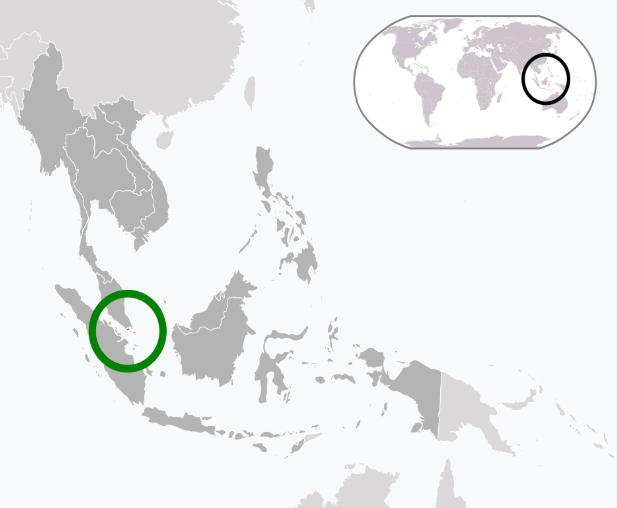
Singapore shown as a tiny dot among massive neighboring countries with huge populations that could theoretically invade it.
Cyber Sovereignty creates an incentive structure that rewards efficiency, as societies which create prosperity will grow and those that don't will be abandoned. If a society manages it's money poorly, violates people's rights or institutes policies which reduce prosperity, eventually, people will leave that society for another society, or make an alternative that reverses those changes.
Digital societies which don't implement smart policies will not survive. This creates an incentive structure that incentivizes intelligence.
For many Western nations, the only path to growth is to think outside the box. Cyber Sovereignty allows for an engine of new ideas to become the vehicle by which nations can unlock prosperity.
*, **, ✱, Specific legal details
Skip this unless doing a legal analysis.
* Adjusted for inflation, 2024 USD.
** Adjusted for inflation, 2022 USD.
✱ Popularity is determined by the total number of people in all the digital societies that agree to a particular framework through their digital society. Only societies that publicly report their statistics of citizenship in a manner count to that number. For this to work one more rule must govern all societies. A person can only be the official member or "citizen" of a single society. Anyone can write an alterative legal framework.
They cannot do so accidentally by in the terms of service related primarily to another subject, or having their citizenship changed without explicitly dissolving one citizenship prior to moving to the next.
No one can sign an agreement that specifies that they will remain a citizen of a digital society for any amount of time.
In all cases when we talk about membership in the manifesto and in this document, we are talking about citizenship.
Necessary legal extracts for legal purposes
These are portions of the document which were too gratuitous to leave in, but are necessary if understanding Cyber Sovereignty from a detailed legal perspective.
Interpretation issues
Precedents in contracts
When using an AI to interpret and create scenarios that undermine Cyber Sovereignty, it's very clear that a non-literal interpretation of everything that's written in the Cyber Sovereignty Manifesto and Implementation Blueprint would easily lead one down a path pretty similar to today's law.
However, every word is written specifically and deliberately in such a way that radically re-thinks how law should be from the ground up.
For example, the ability of a legal corporation to inject into a contract a framework which decides which digital society's rules take precedence is very literal and meant to be interpreted as-is, without regard to the Golden Law, as the Golden Law represents membership within a digital society and ascribing which digital society's rules takes precedence does not constitute membership.
It's on the individual to make the best choice in their own interest.
Rules such as unconscionability on a national level could never overrule the digital society's laws, because if they did, you would have to study every nation's laws of unconscionability, and everyone has different views on what that should be. It would continue the inhibition on the freedom of action.
Specificity
It should be clear that when using the word person or individual instead of party, it's very specifically done to exclude corporations or include corporations within rights.
FAQ
What if some part of a contract touches on a matter not mentioned by a digital polity? Will that still be a digital matter?
Yes, only the parts being actioned at any particular moment, if those do not have a legal statute within the digital polity will then get referred to the physical instead.
==============
==============
==============
ARTICLE LEFTOVERS
==============
==============
==============
==============
Requirements
For a cooperation to seek the benefits of any digital society's law, it's required that that digital society subscribe to the above agreement or one of its top five competitors.
However, any such global agreement can only cover:
- Which digital society takes precedence when multiple parties interact under law.
- What a valid signature entails
- What is considered a valid contract.
Namely,
- General statutes
- Matters of closely held values or ethics.
Finally they cannot create significant or arbitrary restrictions on trade.
- The rules specifying what is considered assent to a contract.
- The rules specifying what sorts of contracts are valid provided they stay close to this framework:
No case shall be made for the revocation of any of the terms of a contract, unless:
- The party in question did not bind themselves knowledgeably or without duress
- This includes consumer confusion through false advertisements prior to signing.
- The execution of the contract would create significant finical destitution for any party involved
- The execution of the contract would constitute a national crime in one of the parties national jurisdictions
- The terms of the agreement would constitute unreasonable long-term debts or bondage.
They may not put undue burdens on the simplicity of trade.
The agreement grants one right on top of general Cyber sovereignty rights. It allows a contract between two members of any digital society to make an agreement which takes precedence over national law.
People, in relationship with a corporation, can choose to be judged by the rules of a digital society instead of physical law in which the interaction and first-order effects are contained within that digital society.
If corporation's want to benefit from the simplicity of digital laws instead of national laws, then there are limits.
Any digital society that would like to host a corporation must subscribe to one of five legal frameworks. These legal frameworks can be written by anyone, but only the five which have been subscribed to by the most digital citizens via their digital societies become valid for corporate use.✱
These frameworks can only be used to define:
-
A single system of precedence so that different digital societies don't try to take precedence over the same issue
-
A single, clear standard for what counts as a signed contract for digital societies
- A single standard for what is considered valid in contracts.
The first agreement already exists.
These frameworks cannot cover matters of closely held values or ethics, including:
- Speech
- Personal identity choices
- Health choices
- Education
- In-home issues
- Religious issues
- Children, family and marriage.
They are only relevant to how legal cases not associated with values get judged when they come up.
It's the obligation of every cyber-sovereigntist is to ensure that these legal frameworks remain focused on the efficiency of trade and commerce and not in the involvement in people's ideas and values.
Regulatory arbitrage
Regulatory arbitrage is where corporations shop around to different jurisdictions to find something favorable for them. In this case, this would only be possible wherein two corporations have an agreement with each other.
Let's say that you find somebody in Digital Polity B, and Digital Polity B did not have any agreement concerning this matter with Digital Polity A. Even though the contract specifies that the individual is subject to the rules of Digital Polity A,
you are overruling the ability of the corporation to set precedents.
It's clear that the current system entrenches old money at the cost of innovation, in that no one can viably start or grow a business without the legal cover provided by a significant financial injection.
However, the danger exists for large corporations to try to use or create digital polities by avoiding meaningful regulation.
A dominant corporation could establish or adopt its own digital legal system with rules designed to minimize its responsibilities. By embedding a clause in its terms of service or employment contracts, the corporation could legally require all customers, suppliers, and employees to be governed by this favorable, private set of laws as a non-negotiable condition of doing business. This would create a scenario where the corporation could effectively operate outside the scope of established national regulations for labor rights, consumer protection, and data privacy, thereby evading meaningful accountability while binding individuals who have little alternative but to agree to its self-serving terms.
Large corporations don't represent our closely-held values or beliefs, nor are they people requiring fundamental human rights. They can however infringe on rights.
What is considered large?
Are their alternatives to their services?
Natural flow
Digital societies, however, are not necessarily the perfect fit to solve all problems between members. They may find themselves underequipped to deal with certain physical matters even if contained to consenting members.
Common sense will lead us to a natural flow which divides natural digital precedence from natural national precedence.
Digital societies
Digital societies are better at:
- Allowing people to truly consent to the system they are subject to
- Adapting to rapidly changing societal and technological circumstances
- Protecting individual rights.
This makes them superior at managing:
- Matters of values, speech, ethics and morality
- Why? Physical government often imposes one view on everyone which can create resentment.
- Matters of economic regulation
- Why? When it comes to day-to-day regulation, physical government is woefully inadequate as it creates regulatory overlap and moves at a snail's pace.
- Matters of non-physical interpersonal relationships
- Why? Physical government lacks the resources to meaningfully get involved in the minutiae of day-to-day connections between people.
- Digital actions or property
- As these matters are digital in nature.
- Etc.
Distinguishing limits
To define if a digital or physical society is more apt to handle an issue, ask yourself:
Digital society
- Required: Are the first-order effects contained mostly to members of the same digital society and their children? If so:
- Is it a matter of deeply held values or beliefs? E.g.
- Speech
- Health choices
- Education
- In-home issues
- Religious issues
- Children, marriage.
- Is the matter intangible?
- Licensing
- Regulations
- Standards
- Copyright
- Commerce
- Digital goods
- Digital speech
- Is the matter economic?
- Is the matter related to networks or the internet?
- Can a response be organized via the internet?
- Does the incentive structure of distributed digital governance lend itself to an honest resolution?
- Is it a civil matter?
- Is it a matter of deeply held values or beliefs? E.g.
If the first point and many of the rest apply, it's likely a matter best handled by digital government.
Physical government
- Does the matter directly effect parties not in digital societies?
- Is the matter at hand tangible and physical?
- Does it require immediate action?
- Does it demand national coordination?
- Does the punishment need to go beyond a fine?
- Does the incentive structure of the physical government lend itself to an honest resolution?
- Is it a criminal matter that does not pertain to deeply held values and beliefs?
If more of these points apply than the earlier points, then it's likely a matter of physical government.
Fundamental principle
Cyber Sovereignty believes, if all individuals involved in a specific situation are consenting members of the same digital society, that society's rules should take precedence over their national system.
Examples:
- Interpersonal conduct: Addressing harassment or abuse.
- Education: Defining shared philosophies or resources for how their children are educated.
- Contracts: Defining how they are interpreted and what's legally permissible in them.
The critical principle is that the first-order effects of these choices, and the application of these rules, must stay within the boundaries of the consenting members of that particular digital society and their dependents.
When an issue falls outside these defined boundaries, the relevant national laws and systems must apply.
Inasmuch as people can opt into them and move between them, they can better defend our rights and create true popular sovereignty at scale. They are superior in matters of:
Regulation of Financial Institutions & Markets.
Anti-Trust & Competition Regulation.
National Scientific & Research Funding
Record keeping, statistics, monetary policy, fiscal policy, taxes.
Financial markets minus fraud. Broadcasting regulation. Labor laws. Workplace safety standards.
Child welfare. Consumer protection. Elections. family law. Civil law standards
Licensing
In general, Cyber Sovereignty seeks to create a new legal framework that covers the evolving nature of how we connect, consisting of laws that fit that nature. As life itself becomes more and more virtual, we need a new system that will protect us and our online-connected communities in how those communities interact with each other.
Boundaries of digital societies
In general, Cyber Sovereignty seeks to create a new legal framework that covers the evolving nature of how we connect with laws that fit that nature. As life itself becomes more and more virtual, we need a new system that will protect us and our online-connected communities in how those communities interact with each other.
Members of the same digital community may interact in matters of trade, speech, or welfare distribution. These matters may touch local issues, as well as
Fundamental principle
Cyber Sovereignty believes, if all individuals involved in a specific situation are consenting members of the same digital society, that society's rules should take precedence over their national system.
Examples:
- Interpersonal conduct: Addressing harassment or abuse.
- Education: Defining shared philosophies or resources for how their children are educated.
- Contracts: Defining how they are interpreted and what's legally permissible in them.
The critical principle is that the first-order effects of these choices, and the application of these rules, must stay within the boundaries of the consenting members of that particular digital society and their dependents.
When an issue falls outside these defined boundaries, the relevant national laws and systems must apply.
Overlap
By default, if a digital society doesn't specify laws or rights regarding a particular issue, local laws must take precedence.
Cyber Sovereignty is not designed for the creation of laws in digital societies regarding spaces where local authorities are better equipped to solve problems.
Better handled by physical authorities
For example, domestic abuse is likely better handled by local authorities who have resources on the ground to separate violent parties, investigate a crime scene and find an immediate shelter for children in danger.
Better handled by digital societies
A digital society is likely better at dealing with online harassment between members.
Natural flow
Common sense will lead us to a natural flow which divides digital jurisdiction from local and national jurisdictions. However, by no means should the right of individuals agreeing to solve problems a different way be overturned unless the first order effects, effect those outside their digital society.
Digital societies organized online are better suited to creating a human, hands on approach to matters such as welfare, justice, and interpersonal conflict as these all happen within the context of a specific community and can be dealt with much more effectively by a specific community.
This document gets into the specifics of cyber sovereignty and the rules by which implementation must take place.
Synopsis
What cyber sovereignty is not.
- Centralized
- singular
- democratic
- revolutionary
How to implement Cyber sovereignty
- DEMOCRATIC MEANS
- Start small testing
This document is designed to guide those who seek to implement Cyber Sovereignty down a shared path.
TITLE
Growing momentum
Cyber-sovereigntists believe that the best way to implement any political idea is to start with small-scale experiments, create value, and build democratic momentum from there.
By nature cyber-sovereignists advocate for working within democratic systems to create the change we desire.
No single digital society should seek to create rules for all the other digital societies, instead, people should be able to choose from a great constellation of digital societies.
To be clear, Cyber Sovereignty believes there should never be just a few digital societies in which people around the world gain citizenship.
Cyber-sovereignists pursue the creation of multiple independent digital societies, each with their own systems of values, laws and rules and reject a world of centralized top-down political compulsion.
Ethics as essential
For centuries, the West fought over which flavor of Christianity to impose on society. They learned through more than a hundred years of painful war that implementing values from the top down on any society leads to resentment.
Learning from these mistakes, many states today legally separate church and state.
As western society leans more irreligious, the concept of a state imposing religious values is replaced by a state imposing societal ethics and ideals. It's important that the fundamental principle be maintained even as society changes and evolves from being purely physical to partially digital. The imposition of ethics from a centralized system on the whole of the internet will create enormous resentment.
Modern context
While modern societies are too often being torn apart by each side trying to impose one monolithic system of values on everyone else, Cyber Sovereignty advocates for a world in which, people can live by a chosen digital societies' values instead.
The internet has allowed people to create highly diverging sets of values and ethics that are becoming harder and harder to integrate into one monolithic system.
When any society imposes ethics on those who don't believe in them, it creates resentment.
Rather than having any system of values and ethics imposed on all society from the top down, where two people opt into a digital society, the rules of that digital society should take precedence.
Imagine a world where, rather than trying to impose matters of ethics on one another, diverse communities organized online were allowed to flourish side by side.
Cyber-sovereigntists stand for a world where people choose the systems of ethics they are subject to.
Many more matters of law touch on ethics then a passing glance would reveal.
, are the ideal vessel to create communities of values, much more than national systems. These chosen digital societies
Many more matters of law touch on ethics then a passing glance would reveal.
Even though these digital communities are organized online, these chosen digital societies can directly shape real-world interactions between their members.
Cyber Sovereignty envisions a world in which eventually most people will inhabit digital societies. It's essential that room be created within national governments to legalize the ability
Cyber Sovereignty stands for an internet free from unnecessary or excessive national regulation in order to create the room needed for opt-in digital societies to manage the connections between their citizens.
National organization is necessary to every country for it to function but Cyber-sovereigntists believe that digital societies should take precedence in matters of values in order to create harmony.
Distributed community model
To achieve Anti Synthesis, cyber-sovereigntists believe that cyberspace should be filled with competing digital polities with their own internal systems of law, welfare, values and justice. Each would have their own requirements for citizenship and manage their own citizen's interpersonal relationships in matters of life, values, trade and commerce.
Polities would compete for citizens by offering a model which balances rights, services and systems of justice.
By creating the best system, cyber polities will naturally attract citizens, leading to more people using the same laws for trade between each other, naturally increasing the prosperity of the polity and the services it can offer to citizens.
The ideal outcome is a series of polities that will demonstrate that they are more efficient and effective than traditional governments at delivering key services, increasing their legitimacy and increasing popular support for significant legal status for digital polities in general.
The mission is to demonstrate the capability of digital polities in managing interpersonal connections in matters of values, trade, commerce, etc. and then mobilizing those people who benefit to advocate to their national governments for real legal status for digital polities in general.
Voting with one's feet
Since these polities manage interpersonal connections, in physical life as well as digital, they allow a whole new concept of how we interact with each other. For example, one polity may allow millions of people from around the world to trade with each other under a whole new system of law that makes international cooperation in trade and commerce easier.
Namely, by reducing the first two branches in size and granting the third more autonomy, a new system of government is created in which people choose from working systems rather than mere ideas.
Cyber-sovereignists advocate for a world in which digital polities take over the functions of national governments that these polities have proven they can deliver on better.
Instead of "voting", as long as people are allowed to move from polity to polity without restriction, resettling to a polity would be a form of vote by itself.
Fighting for control
Cyber-sovereignists believe national governments are under-equipped to take on the massive challenge of a rapidly changing digital landscape. Cyber-sovereigntists believe that digital polities have great advantages in delivering services more effectively and we believe those polities must prove their worth in both the physical and digital realm to command popular support for the implementation of Cyber Sovereignty.
Our goal is a world in which human life and freedom reign through a meaningful choice of systems that effect both our digital freedom and physical lives.
Everyone has the freedom to voluntarily join or leave a polity without excessive hindrance.
No law may impose significant hindrances on the movement of people from one digital polity to another.
Even though these digital communities are organized online, they could touch many points in which two people opt in to a system that they desire to take precedence over their national system.
This means that wherein two people are members of the same community, matters between those two people, in as much as is practical could be governed by a new set of rules they actively choose.
These rules could touch on what medications you're allowed to take, to how you educate your children, to what advertisements you're exposed to, to any hot button issue provided all interactions and implications stay between consenting members of the same community and their children.
If people are given the choice between multiple working systems, where the prosperity of those systems is already actively evident, people naturally choose the systems of commerce that make them prosper.
But, regulation on matters of values and ethics must be limited to avoid this resentment.
The concept of digital societies allows people to architect the systems that manage the relationships between them and their society.
Cyber-sovereigntists believe that digital societies must take precedence in all matters of values between members of those digital societies.
Namely, when two people are part of the same digital society, the rules managing their interpersonal conduct, the terms of commercial exchange and contractual agreements would be managed by the society itself. Only matters in which individuals are not members of a society or matters referred to national governments by polities or significant threats like fraud are dealt with on a national scale.