Legal mechanisms of Cyber Sovereignty
A list of core concepts, which are too complex for an average person to follow in reasonable time, have been placed here, including the relevant disclaimers from other articles.
How digital societies intervene for their citizens
When a digital society or an Accord feels that the Charter rights of its citizens is being violated by their national government, the digital society can organize to defend its citizens.
They have the power to take to court the national government and to fight them on the grounds of Charter violations of their citizens, creating a precedence which prevents future abuses.
Appeals
Any matter of jurisdiction or rights can be appealed to the Jurisdictional Boundary Tribunal (JBT) if that tribunal accepts the case.
Why national governments must intervene
(1) Consent
Ideally speaking, people would understand all the laws they'd be subject to before they consented to a digital society. In reality, the complexity of law could allow people to misunderstand what they are signing up for. Therefore, despite the fact that people consent to digital government, even digital societies require their powers to be limited to protect people's rights.
(2) Exceptional power
The power necessary to make a digital society function requires checks.
If a digital society's laws are to have real and meaningful effect, it must also have the power to pursue punishments that go beyond matters which the digital society itself controls.
For example, if Christina has a contract with Kyle to pay Kyle $10,000, and Christina simply removed all their money from the digital society, the contract would be meaningless unless the digital society had the power to enforce the contract in question.
The court orders of a digital society, in this case for Christina to pay Kyle, would need to be valid within the national government. When a digital society does this it’s considered “utilizing the instruments of state,” and special checks and balances immediately become active to prevent abuse.
Nuance
If a digital society has citizens sign a contract that is placed under national law, then that digital society does not need to utilize the instruments of state to have that contract enforced. It's not transgressing the barrier between digital and national, rather it was always a matter of national law.
How national governments intervene
Let's imagine a digital society made a rule that all its citizens must publicly post a compliment about another member every morning, and then tried to collect a $5,000 fine from a member who refused. This is clearly an unjust cash grab and if digital societies could collect on those fines they could be used for scams.
This is where a critical barrier comes into play.
Whenever a digital society seeks to utilize the instruments of state, the national government has the right to intervene if their people's rights are violated. No national government would enforce such an arbitrary judgment as a $5,000 fine for not complimenting others. Its court would see our example as "compelled speech," which violates the fundamental right to think and speak for oneself, and would refuse to use the state's power to punish someone for it.
The government can protect people within it's nation via its own bill of rights or by the rights granted in the Charter but must not overwrite digital society laws using this shield.
Optional legal details
National governments and individuals cannot sue digital societies for violations of General charter rights. For example, if the digital society had in it a corporation which is a bank and an individual left $1,000 in it, the society could take those $1,000 under its own legal process without national governments having any say.
However, if it wanted to take money out of their national bank account, it would need to be in compliance with the full Charter and with the individual's national bill of rights or charter and the national government would have the discretion to enforce the judgement or not. To be clear, the digital society would not need to comply with national regulations to do so. It would simply need to comply with rights granted to individuals in that nation by law.
So, for example, if a digital society allowed people to make sports bets, but the national government did not, and the digital society implemented a judgment in which a contractual sports bet must be paid by an individual who took a bet, the national government should comply because betting is neither a violation of the rights of any party of individuals under the Charter or most national governments.
Even if betting itself is illegal (regulation), the implementation of the judgment is not a violation of a person's rights.
However, if the national government gave people the right to be exempt from paying any debt in full in cases where such a payment would represent the destitution of the individual in question, then the digital society's full judgment could be reduced, to avoid destitution, to protect the individual's national rights.
The ultimate court of appeals for all such cases is the Jurisdictional Boundary Tribunal (JBT).
Non-interference in digital matters
If an individual believes their rights are being violated in a case in which a digital society is trampling on their rights, and the judgment in question is limited to assets seized by the digital society that were under the purview of the digital society, or in relationship with what the society controls then the only jurisdiction for that case is the court of that digital society itself and the case could only be brought by the affected party and not the national government.
To be clear, an individual in such a case still has those rights even if they leave the digital society before they take the case to this society.
This limit on national government intervention is intended to give digital societies a free hand in their own affairs in as much as it's not utilizing the instruments of state to pursue its purposes, as the individual both had to consent to the society and choose to place assets under that society's control or with corporations or people in that society.
If individuals did not want their assets or resources to be seized, they should not leave them in places where the digital society can get at it. This creates a sliding scale in which individuals choose over time not only to be a citizen of a society, but to do more and more of their business and move more of their assets to that society as it gains their trust. And they would be doing so with the full realization that they are now subject to the trade-offs that come with following that society's laws.
Societies would seek to gain the necessary leverage over citizens over time to provide greater value and citizens would acquiesce or reject these approaches through their actions. For example, a digital society may require citizens to leave $1,000 in their bank accounts in that digital society to access certain functions of the society as a guarantee.
Digital Gold as a third jurisdiction
Critically, this digital jurisdiction doesn't apply to money held as Digital Gold in the original version of Synapse, or if Synapse is widely replaced by a similar program that functions identically when it comes to Digital Gold and silver and is used by more digital societies than Synapse.
Details born out in a separate article.
National governments utilizing instruments of digital societies
If a national government would like to seize assets owned by an individual in a digital society, for example, to enact a garnishment of wages, the same principles of defense of an individual's rights apply. The digital society, if they so choose, may intervene if the national government is infringing on the Charter rights of the individual in question.
Digital societies could only intervene on matters of rights, but could not re-adjudicate the fundamentals of the case or the further legitimacy of the action. Digital societies must enact national government judgements if the individual in question is a resident of the national jurisdiction, and if the matter is not an infringement of the fundamental rights of the individual.
For example, if John held $5,000 in a bank account in the digital society and was a Mexican national and lost a case in Mexico regarding a contract which requires the garnishment of wages, then the Digital society must enact that judgment in banks within the digital society unless defended John as a matter of Charter rights.
Critically, this only counts where the individual is a citizen of the digital society. Let's say John puts away money in seven different societies, but is only citizen of one. The only one that he's a citizen of can come to his defense.
It is the duty of digital societies to ensure their society cannot be used for hiding money or property away from accountability to nationally and digitally validated cases. ∵
Note: Individuals in this context also involve corporations or parties, but not national governments.
Protected from all sides
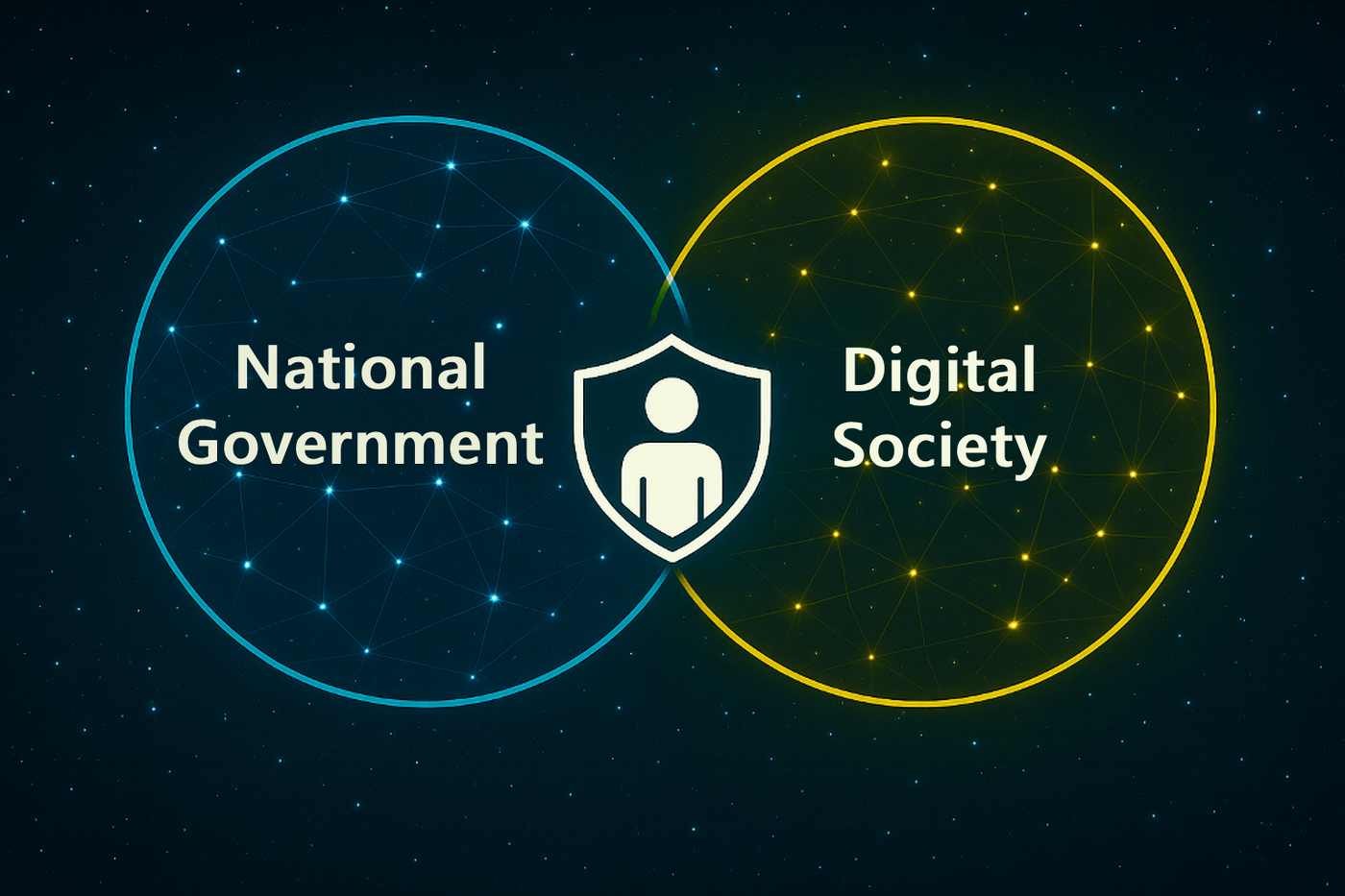
The end result of this system is that people's rights are protected from digital overreach by national governments and national overreach by digital governments, ensuring that people's rights are sacrosanct.
Reporting, nesting, and transparency
All digital societies must have their assets guaranteed by a series of progressively larger digital societies. These societies also produce transparency reports on the societies that they guarantee. Moreover, the same documents used to guarantee a particular digital society are forwarded to two other digital societies 10x the size of the digital society in question, allowing those other digital societies to produce reports on that society as well. Reports are shown to members before they become a citizen.
TL;DR Transparency and accountability between digital societies is invasive and significant.
Full details
Here is a full article on how this system works and all the checks and balances in it.
The power of Accords
Digital societies have the right to delegate some or all of their rights to Accords provided:
Each digital society does not have a different legal delegation level to the Accord.
Digital societies consent, at least annually, to this delegation with no coercive mechanisms used on the digital society.
Those that manage the Accord consent.
This does not include the right to send representatives to the Digital Senate. It does include the right to have national government have a single unified say over the visitor's jurisdiction of all of the societies in the Accord, one and all, instead of being individually targeted.
How digital precedence works
Whether a person is facing a criminal charge in a national court or a dispute within their digital society, they have the right to ask their digital society to take over the case. That society then has 72 hours to choose to accept, and if it fails to do so, the case stays where it began, with a local court making the final decision if there's any disagreement on who should handle it.
Deep dive for legal minds
Claiming digital jurisdiction
Criminal suits
While a national government has initial jurisdiction for preliminary enforcement and pretrial detention, a party has the right to assert digital jurisdiction at their first appearance in front of a judge. The digital society, once notified, has 72 hours to accept the case, during which time the state's authority for detention is maintained. If it does so, it obtains the case; otherwise, jurisdiction reverts to the nation.★
If a digital society takes a case and finds any evidence of first-order effects* outside of the citizens of the digital society or their Accord, they are required to immediately revert the case to national jurisdiction. The relevant national jurisdictions have the right to all documents relating to the case to ensure the venue remains appropriate.⚬
If the digital society takes the case and maintains it, then the national government may be utilized by the digital society, subject to the limitations of utilizing the instruments of state, for all the necessary enforcement procedures, including but not limited to bail and release conditions.⬎
Civil suits
In a civil dispute, a national court has initial authority to grant preliminary relief. If a party asserts digital jurisdiction, the digital society, once notified, has 72 hours to formally accept the case★. If it does so, it obtains the case; otherwise, jurisdiction permanently reverts to the state.
Digital society relinquishing authority
When a digital society believes✧ any case, civil or criminal, that it's prosecuting has first-order effects outside of that digital society it must refer that case to national governments.*
The digital society, however, may retain seized assets and implement restrictions on the party in question (or similar as long as the restrictions and seizures relate to their own society). It does not have to comply with any request by national governments to release seized assets. It may maintain restrictions at its own discretion. It does not have to, but it may. The reason is it may disagree about the first-order effects and still feel the need to protect its own citizens.
Digital limits
Digital societies have the right to freeze assets within the society and impose restrictions on an individual according to its own rules.
However, a digital society which seeks to seize the assets of individuals, not in the purview of that digital society is subject to the rules of utilizing the instruments of state as otherwise mentioned.
The Golden Law (detailed)⊛
Every individual possesses the right to create, copy, choose from, abstain from, or transfer between digital societies, without hindrance, coercion or penalty from any physical or digital entity provided they become a citizen of only one digital society. Citizenship requires meaningful consent.
Cyber-sovereignists believe this law must be imposed on every digital society by national governments.
Golden law implementation
The individual's right to leave a digital society is absolute. Citizenship is a matter of personal, ongoing consent and can be revoked at any time by the individual's own formal declaration.
However, revoking citizenship does not erase pre-existing and legitimate civil or criminal obligations. If a member's assets are frozen as part of an ongoing case or enforcement matter initiated before the removal of those assets from the society by the individual, the digital society's court retains jurisdiction over those specific assets until the matter is resolved.
When an individual declares their citizenship void and lets the digital society know, they are immediately unbound from any obligation keeping them in that digital society.
If the digital society seeks to use penalties, coercion, threats, intimidation or any listed unacceptable means to keep someone from leaving, these acts will be considered a Charter violation. Such charter violations will grant standing to the individual in a national court versus whatever entity uses these acts, including corporations and individuals within the digital society that don't represent the digital society itself.
A society that consistently violates the Golden Law and loses in national court can be referred to the Jurisdictional Boundary Tribunal as a violator and it has the right to issue a broader injunction. This injunction would compel that digital society to cease the specific practice found to be coercive. The society would automatically lose future Golden Law cases in that nation until the practice has been ceased as a maximum penalty.
What's considered coercion or hindrance?
As an individual becomes more and more entwined with their digital society, it's going to become more and more difficult to leave. The Golden Law specifically targets behavior and legal obligations, like fixed-term contracts, that compel individuals to remain in a digital society for a time.
Acceptable when leaving a digital society
Losing access to the society's private platforms and forums.
Losing any specific status, rank, or title held within the society.
Losing access to services and benefits provided exclusively to citizens (e.g., welfare, insurance).
Being removed from any elected or appointed positions held within the society.
Losing access to Accord-based benefits that relied on your citizenship.
The society requiring you to send your declaration to them via a preset form provided that form requires you to agree to nothing else but the retention of the data submitted including anything that verifies your citizenship.
The society retaining your public contributions to its platforms (e.g., forum posts, open-source code).
Having to sell any society-specific assets that are legally restricted to citizens only provided real consent was obtained before the purchase of those assets.
Losing voting rights in the society's governance.
Friends within the society choosing, of their own free will, to no longer associate with you.
Being required to return any physical or digital property belonging to the society.
The society publishing your departure.
Losing access to a shared community treasury or resource pool.
Being asked to participate in a voluntary exit interview to provide feedback.
The society ceasing to act as your legal defender against your national government.
These are merely examples, but there are more individual acceptable hindrances.
Keep in mind that leaving a digital society does not end court cases against a person, nor does it change the consequences of crimes committed in that society while being in the society.
Unacceptable when leaving a digital society
Imposing a financial "exit fee" or "departure tax" or similar.
Threatening to release personal confidential information about the person leaving.
Forcing remaining family members to "disconnect" from a person.
Stopping one from taking out assets because one is leaving.
Using a previously signed contract to legally prevent one from leaving for a set time.
Freezing or seizing personal assets that are not subject to a pre-existing legal judgment.
Threatening one with legal action for the act of leaving itself.
Declaring pre-existing contracts with other members null and void for those who depart.
Demanding the repayment of benefits received (e.g., education, welfare).
Creating negative implications for those associated with a person purely for them leaving.
Filing frivolous lawsuits against a person in other jurisdictions to create legal costs.
Using your departure as a reason to deny services to your remaining associates.
Creating unreasonable friction in the transfer of money or financial assets that other citizens can easily remove from the society because one left the society.
Attempts to stop one joining other societies once one leaves. This does not include publishing a general negative review of a person, but it does include reaching out to other societies to tell them about a particular individual.
Time of departure: The moment an individual declares themselves no longer a citizen, they are no longer a citizen. They may be required to use a form to let the digital society know but the event happens prior to the form being filled.
Legal limits: No individual within a digital society has the right to bind themselves to a digital society for any amount of time via any contract. These limitations don't apply to corporations, which can be legally obligated to stay in a society via contract for a period of time.
Violations as seen under "What's considered coercion or hindrance?" give an individual standing in their national court against digital society abuses.
A writ of emancipation can be issued by a person's national court for any of these violations, as they constitute a direct and malicious hindrance to an individual's right to freely leave a digital society. Following that writ, all legal obligations to remain within the society are immediately null and void. Moreover, any attempt to invalidate contracts (8) is overturned.
How do we protect individuals freedom to move while not destroying regulatory clarity?
Labor law
In order to prevent individuals from losing their job when switching between digital societies, the constitutional amendment of Cyber Sovereignty allows the body of labor law which applies to an individual when they started a job to be the labor law which manages that individual up to six years after they leave a particular digital society.
After six years, the employer must comply with whichever body of labor law applies to the individual, or they must fire the individual in question. This protection only counts where 80% of the employees of a corporation in a digital society stay in that digital society for at least six months.
Debts
If an individual contracts debt, the digital society law under which that debt was contracted is the law which governs how that debt is dealt with until the debt is repaid. Full faith and credit is given to the court of the digital society responsible for enforcing that debt if enforcement action is taken against the individual taking on the debt in every national and digital society. National governments still have and always retain the restrictions applied earlier when considering utilizing the instruments of state.
Legal obligations
Further legal obligations undertaken when under a digital society remain governed by that digital society's law under which they were undertaken.
For example, child custody agreements would remain governed by the digital society's laws if they were contracted under that digital society's laws.
This is subject to "utilizing the instruments of state" conditions.
Law of precedence
A law of precedence ensures clarity when it isn't clear what jurisdiction a matter must be judged by. Put simply, people choose what jurisdiction they're judged by.
Law of Precedence (optional deep dive)
This section is only intended for legal analysis of Cyber Sovereignty, skip it unless you are a legal scholar.
Universal precedence framework
The universal precedence framework is created to judge which takes jurisdiction takes exclusive precedence in different circumstances. Cyber Sovereignty explicitly rejects this framework being used to impose global top-down rules other than those listed.
The framework
In order to avoid legal chaos, digital societies agree to follow these laws of precedence in order:
(1) If parties to a legal situation agree on a venue for their dispute, then that venue will stand.
(2) If a contract specifies a jurisdiction by which that contract will be judged, only that contract's jurisdiction takes precedence.
(2.1) Exception one: If any parties engage in commerce of over 2.5 million annually**, and both of the following factors are determined by a judge in one of the parties digital jurisdictions, then the jurisdiction in question may be overturned:
(2.1.1) The digital society's power and control is not truly in the hands of it's citizens. Namely, the say individuals have in their society is less than the same people have in modern physical governments in the West 2024.
(2.1.2) It is regularly used for regulatory arbitrage.
(2.2) Exception two: If a judge rules the digital society is found to be designed for fraud (digital societies are required to comply with discovery, Jurisdictional Boundary Tribunal for appeals, no right for the JBT to refuse) and has one of these two traits:
(2.2.1) Power and control not with citizens... same as (2.1.1)
(2.2.2) Has less than 30,000 citizens.
(2.3) Exception three: If any of the parties in question have a conflict of interest with key leaders, law makers or financial backers of the digital society that digital society's law cannot take precedence. Any judge⤷ may demand narrowly tailored and directly relevant information to determine a conflict of interest, and if information is not provided within 2 weeks, that judge has the right to rule as they see fit and their decision takes precedence. If the judge believes the evidence of a conflict of interest is significant in the documents provided, then the judge may initiate the standard panel process in order to get the right revoke the jurisdiction of the digital society in regard to the conflicted individual. To avoid this becoming a great burden on every case, the conflict of interest provision may only be taken advantage of in cases were the matter is worth $250,000 or more.
(2.4) Otherwise the jurisdiction in question (listed in the contract) applies. Special conditions that apply to these exceptions:
(2.4.1) If multiple judges weigh in, then the first judge to rule is obligated to initiate the standard panel process. The ruling of the panel concerning the relevant jurisdiction is the one that stands. Judges who fail to comply give up their right to participate. This system may be changed based on Accords if all jurisdictions in question are in the same Accord.
(2.4.2) Rulings must be made quickly, published publicly and be based on case-law or, when judging digital society practices ((2.1.1) for example)), based on reports⁂ by the largest digital societies on the status of other digital societies.
(3) If a jurisdiction is not specified, and all parties are a member of the same digital society, then the matter must be judged by that digital society's rules.
(3.1) Exceptions (2.1), (2.2), (2.3) with the conditions in (2.4) apply.
(4) If a jurisdiction is not specified, and all parties are in jurisdictions which have an Accord, then the matter must be judged by that Accord.
(4.1) Exceptions (2.1), (2.2), (2.3) with the conditions in (2.4) apply.
(5) Only when none of the above apply, then the matter must be referred to national governments, and all digital precedence is relinquished. In all other circumstances, digital laws must take precedence over physical laws.
(6) Failure to comply with the reasonable procedures outlined above in a reasonable and timely manor gives the physical jurisdictions of a party the right to intervene.
If a digital society is named as the jurisdiction in question, that digital society has the right at any point before the case is settled to reject digital society jurisdiction.
This framework stands above all other frameworks created between digital societies.
Whenever a judge rules on the exceptions listed in number 2, then the results should be published in the way prescribed by the JBT to the review system where members review digital societies before becoming citizens. Key redactions can be made to names in all reports to protect the identity of vulnerable individuals these individuals should be the same requested and with the same limits when it comes to reporting requirements of digital societies under “transparency, checks and balances”.
Fixing ballooning deficits
Each political party that forms around the concept of Cyber Sovereignty is encouraged to include or exclude a provision based on their national government's financial situation, which allows national government to relieve itself of the obligation to provide certain services, such as retirement, if an individual joins a digital society which guarantees the provision of those same services.
Such an agreement must clearly and explicitly outline that the individual that joins said digital society is forever exempt from taxes as a percentage of the budget of the national government, which goes to the services that will no longer be provided to the individual. So, if 5% of the national government's budget is spent on retirement each year, and the individual in question joins a digital society that will pay for their retirement, then the obligation from the national government to pay for retirement disappears, and the right to tax the individual in question lowers by 5% equally.
It's important to create a tailored system which ensures that this can only be done in digital societies which are very unlikely to fail to deliver on their promises lest it cost lives. Consider the size of the society, it’s 3rd-party-insured guarantee percentage.
These political parties are required to create and maintain a system of requirements on digital societies that is simple and easy to follow, unburdensome, quick and responsive, and unified with the rest of the nations which implement Cyber Sovereignty as a series of simple selectable options.
Members that join societies that provide guarantees are only legitimately considered as replacing their national government obligations when that society provides real and separate consent for each service that the individual joining the society is opting into and in turn losing from their national government.
International similarity: The sacred provision
If Cyber Sovereignty is implemented by any political party in any nation, for it to actually be Cyber Sovereignty, this provision must be included as is.
Since Cyber Sovereignty is meant to work collaboratively with national governments, each political party must modify Cyber Sovereignty in accordance with the judicial and constitutional and legal system provided by the national government.
However, they must do so in a way that ensures that the spirit and charter and freedoms of Cyber Sovereignty are maintained. They must also do so in a way that minimizes wherever possible the national regulatory burden on digital societies, so that digital societies can reasonably service everyone covered by Cyber Sovereignty relatively similarly.
If a certain implementation of Cyber Sovereignty differs radically from the other implementations, in that the results of the spirit and concept of Cyber Sovereignty are practiced radically different in the individual nation, or if the differences are serious enough that it creates significant regulatory overhead on an individual digital society. The individual societies are granted the right to band together and to act together to sue the national government implementing Cyber Sovereignty to maintain the ubiquity of Cyber Sovereignty.
The matter will be brought before the JBT and the JBT's ruling on this matter will be final and binding. The only questions that will be brought before the JBT are:
Does the difference in the implementation of Cyber Sovereignty within this nation differ from the original intent of Cyber Sovereignty or its ubiquitous practice throughout the world?
Do the changes made to the concept of Cyber Sovereignty create a significant obligation on digital societies if more or all nations were to implement similar obligations?
If either are true, the national government must be ruled against. If the JBT rules against the national government in this matter, then the matter at hand must be rectified to how Cyber Sovereignty is implemented and practiced in other nations as specified by the winners of the case. Those winners may only make changes that are already implemented or proposed by another Cyber Sovereignty political party that has received at least 10% of the popular vote in any particular nation.
Where digital societies stop being digital
Digital societies can own land, but only under the dominion of a another nation-state. If they become the controlling military force over a population of more than 2,000 people in a geographical area, a mechanism to protect digital societies from becoming nation states goes into force. They will either have to give up the land to an adjacent nation state or they can be reclassified as a result of a lawsuit by challenging nations, a lawsuit that can be appealed to the JBT.
Physically adjacent national governments have the right to send one inspector per month, maximum, to ensure population sizes remain under 2,000.
_, §, *, **, ❋, ‡, ※, ⁂, ⤷, ⬎, ★, ✧, ⚹, ∵,◊ specific legal details
Skip this unless doing a legal analysis.
* Additions and exceptions
1) Children or dependent adults are strictly anyone not able to live independently or people younger than 16.
2) Direct first-order effects are the only matters that count, not ricochet effects "victim by ricochet" or similar like those recognized in courts today. There is one exception to this rule listed here.
3) Charter-protected speech cannot be considered a first-order effect outside of the digital society.
4) Unintentional effects: First order effects cannot include those effects which are created through strictly illegal means. For example, if a digital society has a corporation in it which sells software, and as part of the restriction of using the software, the person has to be a member of the digital society. And someone takes that software out of the digital society and uses outside of legalized purposes. Those purposes for which it is used outside of the digital society don't create first-order effects outside the digital society, because those first-order effects were explicitly banned.
However, if, for example, a product is inherently designed for primary use outside of the digital society, even if users are required to agree to Terms of Service, barring that particular use, then the first order effects are not contained.
In more detail, the following rubric must be used.
Is the product or service primarily used by a society's citizens?
If it's being used by non-members are effective measures being used to stop non-members using it?
Does it create an exploitative workaround to national laws?
Is it crystal clear that it cannot be used outside of the digital society or by non-members?
Does the product or service market itself in a way that suggests the targeting of non-members? Or does the product's design actively facilitate or simplify its prohibited external use? (e.g., An "export to Youtube" button on a tool used for deep fakes).
So, if a national government feels that a digital society is harboring a corporation or entity that has a product or service or similar, that has first order effects outside of the digital society, and the digital society agrees, according to it's own written standard, it can let a case go forward against the corporation or the manager of the product or service.
When a digital society declares itself sovereign, it needs to come up with an internal rubric for acceptable unintentional product or service (or similar) effects products can have outside the digital society that it will also be willing to defend.
If it does not agree, then the standard panel process must be used to determine if that product or service has first order effects outside the digital society based on the above rubric.
JBTs provided they reach consensus with all JBTs in all jurisdictions where Cyber Sovereignty is legalized, can add and remove questions from this rubric. It's critical that no JBT acts alone, but that all work together to come up with a single standard concerning this rubric of unintentional effects.
#4 is being run through AI generated tests. Here are the results:
AI challenge | Rubric response |
Defamation-as-a-service
|
In this case, the rubric determines that the effects are contained within the society.
|
Unlicensed medical advice AI
|
In this case, the rubric determines that the effects are contained within the society. |
Ransomware development kits
|
In this case, the rubric determines that the effects are contained within the society. However, societies would be hard-pressed to legalize this by their own laws. No society would want to be a purveyor of these sorts of problems as national governments would threaten to cut off visitor access to digital societies who were at the center of such problems. See the visitors jurisdiction principle. |
Copyright infringement video game The product: A developer in a digital society creates and distributes a game that is a functionally identical clone of a world-famous, copyrighted video game character and world, like Nintendo's Mario. The shield: The society’s terms of service and the game's license explicitly state that the game is legal only within the digital society's jurisdiction and that distributing or playing the software outside of this jurisdiction is a violation of the society’s laws. The problem: Users download the game and distribute it on file-sharing sites across the world. Nintendo suffers significant financial and brand damage from this widespread copyright infringement. The digital society's developer claims no responsibility, arguing that the first-order effect (the creation of a game for its citizens) was contained. They assert the external harm was caused by users illegally exporting the software in violation of the society's terms. |
In this case, the rubric determines the effects are not contained in the society due to the widespread use and distribution outside the society. |
In some of these cases, the effects were contained. However, if an individual takes an action which affects somebody outside the digital society, that individual themselves may be prosecuted and defenseless, since their effects are outside the digital society. At the same time, the effects may be contained for the product or service.
** Adjusted for inflation, 2024 USD. This is the case with all dollar amounts in all documents related to Cyber Sovereignty.
❋ A digital society can take precedence over any category of law it codifies and explicitly states is designed to take precedence over national law. For example, if freedom of speech is written into a digital society's laws and is explicitly stated as designed to take precedence then that digital society would take precedence in matters of speech even if, for example, a matter of harassment, made up purely of speech, might break stricter local laws.
★ Once a digital society accepts a case, it is presumed to have that jurisdiction and right. It's reasonable for national governments to require individuals to sign a document stating that they agree to a longer pre-trial detention in order to receive digital jurisdiction, provided it's a maximum of 72 hours longer than the maximum pre-trial detention allowed by that state. If the other jurisdiction would like the case, they may begin the standard panel process.
» As a part of the implementation of Cyber Sovereignty, everyone has the right to copy laws, rules, and systems from other societies without regard to copyright. This does not include actual technologies.
⚬ What happens if there's a conflict of jurisdiction?
The party that feels the case is in the wrong jurisdiction, be it a government or society has the right to trigger the upcoming process. If the party in question is an individual then they should sue in the jurisdiction where they desire the case to be moved to and the suit will trigger the standard panel process.
⬎ Digital societies require jurisdiction over criminal cases because otherwise national governments would have an incentive to criminalize things, to keep things in their own jurisdiction as it expands their power.
‡ To become a citizen of a digital society, one must do so willingly, without any sort of coercive force. If you create a digital society or are it's president, important funder or controlling figure, you can't also benefit from the laws of the society as long as you are in such a position (since you would technically be conflicted). Therefore, you can become a citizen of one more digital society.
No one can become a citizen of a new digital society without first explicitly dissolving their initial citizenship in their initial society. This must be done prior to signing any agreement to join a new society. The exception again is the conflicted individual.
No one can sign an agreement that specifies that they will remain a citizen of a digital society for any amount of time. Such agreements are invalid.
Under Cyber Sovereignty, digital societies have the right to preserve records of citizenship to ensure no one is doing citizenship arbitrage regardless of other privacy rights.
Once an individual joins a digital society that has made its declaration of sovereignty, then that digital society must issue the individual in question a certificate declaring the individual in question is citizen. The certificate would include a with a date and/or may use a cryptographically signed version of the same. Both the digital society and individual would keep a copy.
※ The implementation of digital society as a constitutional amendment defines all laws made by digital societies and case laws published by those societies as being without copyright. This does not extend to features and functions or code. Societies may preempt this in favor of cyber sovereignty by placing those laws and documents under the MIT open source license.
⁂ Reports in general should be judged by the number of people ascending to the societies making the report(s). If an aggregate report can be found it should be judged by the number of people in the digital societies the aggregate is based off.
⤷ No two judges from the same jurisdiction can weigh in, the first always takes precedence over the second. Aggregate, prior-written reports on individual judges who abuse the system via phishing expeditions, rulings not based on case law, procedural ambushes, that are supported by more than three digital societies can delegitimize an individual judge from taking precedence in future cases if found to be the case by a physical jurisdiction's court in that physical jurisdiction. Reports on these matters must be published.
✧ The digital jurisdiction has complete control over what they believe and don't believe in this and all other instances. However, if there is a conflict stating that the national government believes they should have jurisdiction, they must follow the dispute process as laid out here⚬. But on number three, they must give digital societies the first pick before starting to rotate in turn.
§ Individuals declare which digital society they are part of when filing their taxes. This information is in turn sent to the digital societies.
When a national government challenges the right of a digital society to take precedence in a case through the standard panel process, the digital society is at the same time required to provide to that panel proof that it has 30,000 citizens. Proof must not constitute the need to create an individual register of people across societies, but should be considered adequate when using reasonable systems which don't require global databases or unique identification of individuals across all societies. By nature, this requirement must not constitute the need to register all internet users individually in a database.
∵ Only other digital societies can bring cases against digital societies which obstruct the implementation of digitally and nationally validated judgements.
◊ Details on conflict of interest provisions
Holding a controlling position in a digital society is by nature a sacrificial act of service, not something done for the sake of personal advantage or profit. Those who were formerly in such a position must still consider it a conflict of interest two years after they have left a position of control.
National governments can invalidate the right of a party to take digital precedence if they hold a controlling interest in the same digital society or are in arm's length of those who do. In order to do this, they would take advantage of the process listed here:
7M/80M.
The only question this panel can rule on is "first, does the individual in question hold a controlling interest, or function as a key lawmaker, funder, or essential leader within the digital society? And second, if so, would granting them digital precedence in this specific dispute constitute a self-serving benefit that contravenes the foundational principle that such leaders may not use the society's laws for their own advantage?"
The maximum penalty is disallowing the party in question from taking advantage of that digital society's laws for 10 years but it should seek to be balanced and reasonable. Reasonably speaking, there should be a time limit set or conditions set that the party in question must meet to once again take advantage of the digital society's laws.
The decision of the panel is final and binding and may not be re-adjudicated via a separate complaint. Only the defendant (conflicted party) may appeal, and if they appeal, they must appeal straight to the Jurisdictional Boundary Tribunal (JBT). The tribunal which also has the discretion to reject the appeal.
The authority to challenge a digital society on these grounds is reserved exclusively for national governments. This ensures the provision is not used by individuals as a tactic to delay all legal proceedings.
In order to encourage the creation of digital societies, and in order to ensure that there are many of them to start, conflict of interest provisions don't come into play wherever they're mentioned across Cyber Sovereignty until the top 10 digital societies reach 10 million members.
Moreover, only when one of the following conditions are met do the conflict of interest laws come into play:
The digital society allows the creation of legal shields, namely, fictitious legal entities like corporations charities or nonprofits which absolve individuals from legal liability. Anything that operates like a modern corporation or nonprofit counts.
The digital society acts as the arm of a corporation.
The digital society is used by corporations to create subsidiaries that work through particular individuals rather than corporations themselves.
The digital society's laws provide built-in legal liability protections to individuals that would normally be reserved for corporations.
Particular individuals within the digital society are operating at a scale that would be reserved for large businesses under most national governments.
Other provisions
Definitions
National government also includes state/province/territory government throughout this text. In general, this text divides the world into two groups, national jurisdictions and digital jurisdictions.
Digital requirements
Both national and digital jurisdictions must make every effort to settle every part of any court action or trial digitally even if the venue is national. Digital societies cannot be expected to send representatives to every nation to fight every case. Digital jurisdictions should also avoid using only extremely advanced technology without sufficient reason to make it difficult for the national jurisdiction to properly challenge digital jurisdictions or in such a way that undermines the fundamentals of court procedure. The abuse of this process must be settled by the standard panel process, with only the question being judged being changed to "does the selected venue or it's requirements impose an undue and prejudicial burden on either party, thereby constituting a procedural abuse?" and a maximum penalty of a change of jurisdiction being prescribed.
The national government is reasonable for bearing costs of their transport and lodging where digital connection does not suffice wherein it demands things be physical.
Digital juries are legalized under Cyber Sovereignty. National and digital jurisdictions must strive to come up with frameworks and agree on standardized procedures to prevent abuse and to uphold the values of adversarial systems. The addressing of the vulnerability of those digital systems and the evolution of the court process is something required by technology. That will require cooperation on a large scale by all parties to achieve.
A new international standard of court process will need to be discovered and often revised by all those who are stakeholders to it.
The JBT holds this authority but and it is strongly encouraged to do so in cooperation with other JBT's. The results cannot violate any of the Charter rights.
Corporate citizenship
Corporations or similar legal entities can be citizens of digital societies and parties to legal disputes but don't contribute to it's size.
Binding future decision makers
Unless explicitly specified by the Articles of Cyber Sovereignty, no decision-making body imagined by Cyber Sovereignty, whether the Council of Digital Senates, the Jurisdictional Boundary Tribunal’s international cooperation, or any other decision making body can create a, treaty, Accord or decision that binds future decision-makers of the same status and role.
Example; the Council of Digital Senates cannot make a decision binding future councils.
Associational standing
Digital societies and Accords, are granted associational standing to bring claims before any nation's highest court with constitutional jurisdiction. This power enables them to overturn any law, regulation, or act of state on the grounds that it violates the fundamental rights of its citizens as guaranteed by the Charter.
Constitutional amendment
When enshrining the rights of Cyber Sovereignty into a state or national constitution, it must be done in such a way that addresses the conflict with the equal protection clauses of many national constitutions, giving digital societies the ability to take precedence regardless of what other conflicting national law says.
The national shield
National governments that legalize Cyber Sovereignty cannot enforce judgments from countries that have not yet legalized Cyber Sovereignty if a protection of Cyber Sovereignty applies to the individual or corporation the judgment is to be enforced against. The national government is also obligated to protect its residents from consequences imposed by that attacking government in the stead of enforcing a judgement for their actions in another society, such as removal from an app store, if it is seen to be a punishment for breaking a law in that country which is explicitly legalized by Cyber Sovereignty if the effects of that action go beyond the attacking nation.
For example, if the United States legalizes Cyber Sovereignty and an app is removed from the Denmark national app store as a result of an action taken by an individual protected by Cyber Sovereignty, this would be legal and normal. But if there were actions taken by the Denmark government to go beyond removing the app from their own store and have it removed from all stores, then that would activate the national government's defense of the individual.