Principles behind Cyber Sovereignty
Inspired by problems
We're living through a time of the incredible expansion of government. Governments are becoming less and less competent, trustworthy, and reliable and are charging citizens more and more for the the privilege of having them.
The fundamental problem is inherent to the systems we've created.
(1) Government without sensible standing
The architects of our present system didn't truly understand that rights are always perpetually diminished by the natural flow of government and that the only way to hold in government in such a way that it protects people's rights through not overreaching onto them is to create absolute guardrails based on fundamental principles.
Every entity which has some power and the ability to expand its power will more often than not expand its power to its maximum extent to the detriment of those unable to expand their power. In a government-people relationship, the government almost always has more power to expand its power than people leading the growing bureaucracy overtime until the system breaks.
Since our system of government wasn't founded on absolute principles, and because entities always tend to grow their own power, the growing reach of government is inevitable. Therefore, Cyber Sovereignty proposes placing government on several unchangeable philosophical pillars.
(2) Checks and balances
The checks and balances proposed by the architects of our current system failed to comprehend how those checks and balances would be undermined.
The idea was that the branches of government, fueled by "ambition," would check each other. This model begins to fail when a powerful, external force, money, can align the interests of actors across the different branches.
Moreover, when party loyalty, often funded by the same ideological mega-donors, becomes paramount, the system breaks. Instead of checking each other, members of the same party will work to consolidate power, regardless of branch, not check it.
This creates a centralized moneyed interest, often hijacked by corporations, that has an interest opposite to the people.
Cyber Sovereignty solves this problem by greatly breaking up the power of government between different digital societies, which all have the sort of close-knit accountability that was possible when rural constitutional democracy was founded.
It also creates a new layer of checks and balances by playing off the ambitions of digital vs national institutions in a way that purely focuses on rights-defense.
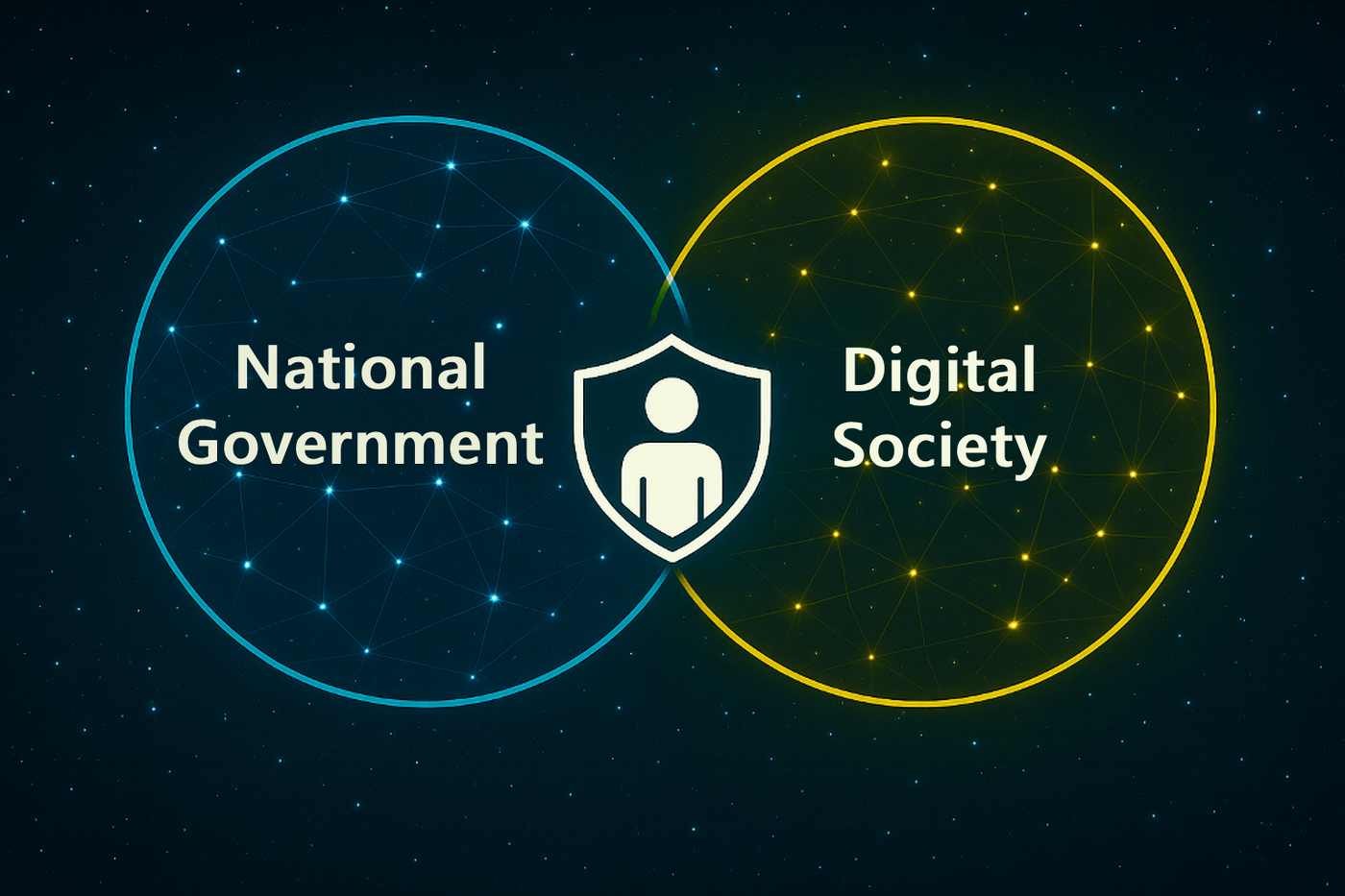
Both use the Charter and national governments use the Bill of Rights to limit the other's power.
Three parties
Cyber Sovereignty does its best to create a situation where there are three parties to every significant case. If a particular body has an incentive to prosecute an individual or society, that prosecution must happen on the turf of another jurisdiction, wherever practical. This ensures that the deck is not stacked against any particular individual or society.
It isn't practiced universally throughout Cyber Sovereignty in every case, but should be interpreted as the correct jurisdiction for future unresolved situations or cases not covered under Cyber Sovereignty so far.
Core beliefs
(1) Consent
Cyber Sovereignty believes that the only legitimate grounds for government power is consent. Consent is a real and thoughtful decision to agree to a series of ideas or system of rules for which there are genuine alternatives.
Consent should be:
Freely given: The decision must be made without coercion, or significant penalty for refusal. The individual must have a genuine choice.
Informed: The person consenting must be provided accurate information and must explicitly state that they have read that information.
Unambiguous: The act of consenting must be a clear, affirmative action. Pre-checked boxes or consent implied from inaction (e.g., "if you don't opt-out, you consent") are considered invalid.
Updated: Consent must be re-obtained if one party changes the terms.
Consent does not have to be:
Granular or individualized: A person can consent to a whole host of laws, ideas, and rules at the same time.
Power-balanced: The parties do not need to be of the same standing.
Comprehensible: It's the responsibility of the individual to employ the help necessary to go through the meaning of documents.
Time-limited: Consent does not need to be updated as long as the original terms have not changed.
Sound mind
Anyone able to live independently, or 16+ and of sound mind, is considered able to give consent.
Golden Law
Everything is subject to the Golden Law. This means individuals are able to withdraw their consent going forward.
(1.1) Non-interference
Moreover, the government should not interfere in matters where all the individuals involved in a matter are truly consenting to that action and not affecting others.
Example of polygamy
The United States interfered with Jehovah's Witnesses when they decided to engage in polygamy. If all parties to a matter are consenting, and able to consent, then there's no basis for government interference, no matter the religious or moral implications.
In a monolithic system, there can only be one definition of marriage. But in a plural system, like Cyber Sovereignty, there can be many. Each community can live by its own rules, provided all parties consent.
(1.2) Parental supremacy
As consent is the only basis of government rule, and by nature a child cannot truly consent to government. The only viable government for a child is a parent.
Edge cases
We are entering an era where children may be born without parents. And in such cases the guardian of the child, or if no guardian is found, the child themselves at the earliest possible stage is the closest we can get to consent.
(2) Individual responsibility
When people agree to do something, provided the first-order effects stay between those people, they should be given the right to do so without further intervention provided they consented.
Critically, an individual cannot withdraw consent for an event that has happened in the past.
(3) Diversity
Since human beliefs are so diverse, and their perspectives on truth often contradictory, rather than imposing one view or set of values on everyone, room should be created for multiple sets of ideas and systems to flourish.
No single group's version of morality or dignity may be imposed on other groups.
Legally, emotional, psychological, or spiritual harm, or offense to public sensibilities, are not grounds for any law or limitation.
(4) Freedom of expression
The freedom of speech as specified by the Charter is designed to be a comprehensive list of exceptions, so that nothing else can be added to them. This prevents tyranny through exceptions. However, expression is much more than just speech.
Human beliefs without their corresponding expressions are totally meaningless. Therefore, to grant people the right to believe something without the right to express it is a meaningless right. The only way to ensure true freedom is to protect people's right to act on their beliefs.
(5) Open source government
Cyber Sovereignty encourages universal participation in the improvement of the systems we are all subject to. Anyone can start, grow, copy and manage a digital society. The right to copy» means anyone can clone a digital societies laws, and structure without hindrance. This leads to a bottom-up, competitive and experimental approach inspired by open source.
(6) Polycentrism
Multi-interpretable
Cyber-sovereignists believe the best way to ensure people's freedom is to create room for multiple systems to rise with none of those systems imposing its values on the whole internet.
Not even a single interpretation of the Charter must impose itself on all digital societies, instead, each nation will have a different interpretation of the rights of the Charter.
Decentralized
Cyber-sovereignists oppose the formation of any new single global power trying to control the internet, whether that power is national, internet-based, democratic or otherwise. Any attempt to unify the humanity under a single system of government or court system or similar, will eventually be co-opted to the harm of liberty. Therefore, each nation's interpretation of the rights of Cyber Sovereignty are different.
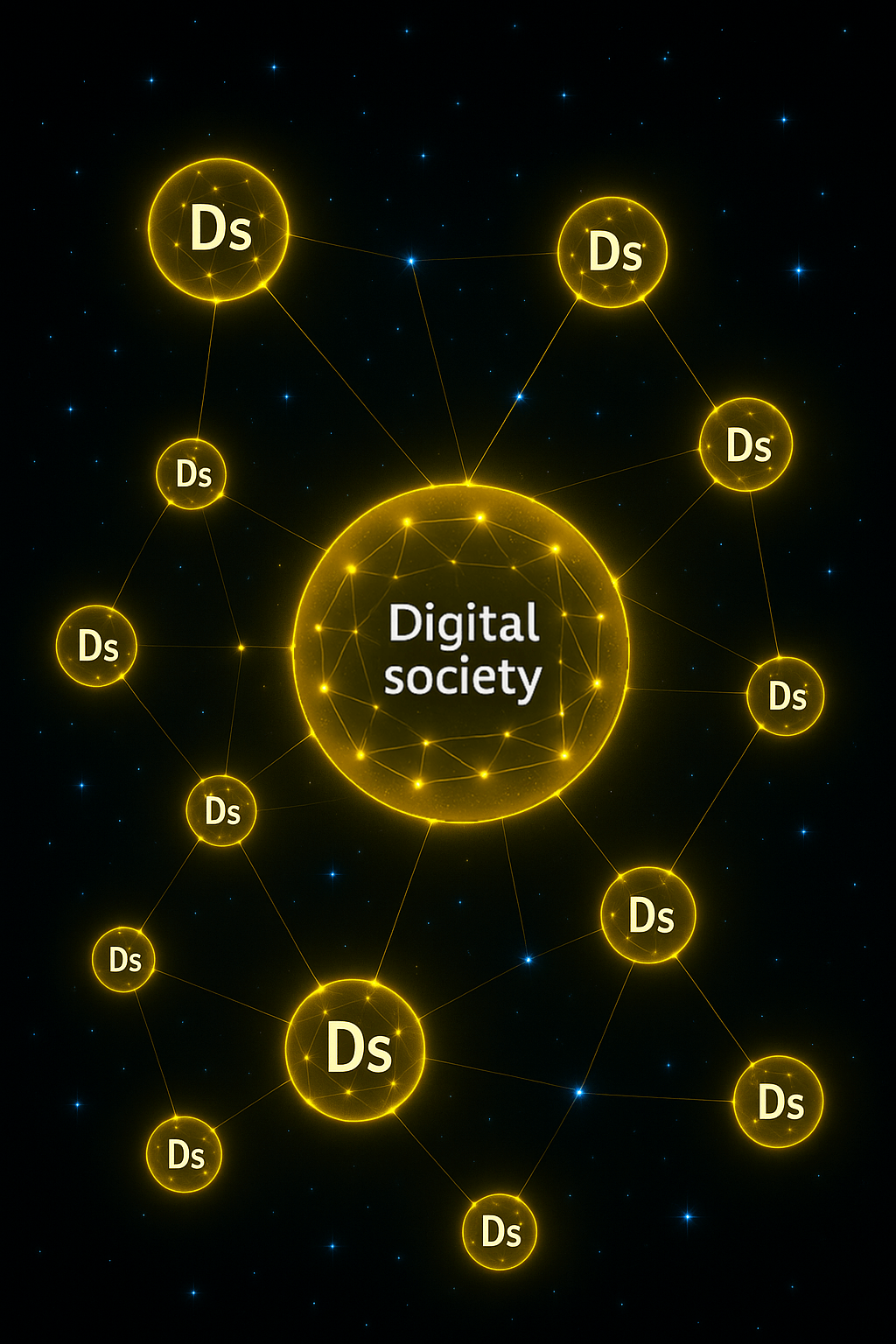
Cyber Sovereignty also oppose a handful of digital societies dominating cyberspace, instead digital societies must become a proliferation of different systems so people can choose from a great constellation of systems of government.
(7) Sovereign
Digital societies are not subject to a nation's laws, but nations are used to keep digital societies in check by limiting their ability to utilize the instruments of state and by imposing upon them The Golden Law. Other than through the Jurisdictional Boundary Tribunal. Governments don't have the right to further interfere with digital societies, as digital societies are sovereign entities within their allowed jurisdictional boundaries.
Restoring freedom of action
The number of rules and regulations to undertake the ordinary actions of life have become so large that only criminals and monied interests can thrive.
Instead, an environment must be created where anyone undertaking an ordinary action of life should have the freedom to undertake that action with reasonable moderation.
Principle
Any action undertaken by an individual that harms another cannot be punished inordinately beyond the harm created.
Ask:
Was it reasonable for the individual to think harm might come from their actions?
Did the individual intend to cause harm?
Does the punishment reasonably deter similar crimes?
Does the punishment align with the act?
Does the cost of executing the punishment place an undue financial burden on taxpayers?
Does the punishment lead to a high re-offense rate?
Intention
To allow people to take actions without asking permission in any avenue of life knowing that if they cause harm to others, that the punishment inflicted on them will be related in degree to the harm created.
Example
A Louisiana man was sentenced to life in prison without parole for shoplifting a jacket worth $159.
So what is a reasonable punishment?
The person reasonably understood that harm might come from their actions.
They intended to cause harm.
The person must be significantly deterred from doing it again.
A fine of $2,000-3,000 would align with the act committed.
A fine would help cover court costs.
Sending people to jail for small crimes may just give them an education in committing more crimes.
Role of parents
The role of parents in matters of values must be absolute.
(1) Governments must never again seek to use education as a means of propagandizing the children of a society.
Parents have the right to direct the destiny of their children and to be the biggest influence upon their lives and their thoughts.
(2) Parents must be prevented from physically and s*xually abusing children.
Mere common physical discipline, as is normal in certain cultures, must not be banned, but parents must by all means be prevented from the physical or s*xual abuse of children.
Strict interpretation
The founding documents of Cyber Sovereignty are meant to be interpreted quite literally based on the core beliefs.
Technology agnostic
Regardless of the newest frontier of technology, these rights must be applied in new and evolving contexts as interpreted by the people.