Core concepts
While the prior articles offered a cursory overview, this document provides the comprehensive analysis of Cyber Sovereignty's core concepts critical to its implementation.
Truly understanding what Cyber Sovereignty will look like once it's implemented is critical before embarking on this journey.
The Golden Law
When implemented, Cyber Sovereignty would allow digital societies to operate as independent legal entities within multiple nation-states.
These societies are sovereign, in that they are not controlled by national governments. No registration is required to create one. The law that creates the general right to participate is called the Golden Law:
Golden Law - Everyone can create, copy, choose from, abstain from, or transfer between digital societies, without hindrance, coercion or penalty from any physical or digital authority. ⊛
Consent
The key concept is that no one can ever be forced to stay in a society they don't continue to agree with. It's liberty through meaningful options and the ability to move between systems of law, welfare, values and justice, organized online.
Boundaries of digital societies
Citizens of the same digital society may interact in matters of speech, trade, welfare distribution, etc., matters which have very tangible, physical impacts but are organized online.
Examples:
Contracts - defining how they are interpreted and what's legally permissible in them
Education - defining shared philosophies or resources for how their children are educated
Welfare - defining who gets which benefits under what circumstances.
Cyber Sovereignty believes, if all individuals involved in a specific situation are consenting citizens of the same digital society, that society's rules should take precedence over their national system.
Effects principle
The critical principle is that the first-order effects of these choices, and the application of these rules, must stay within the boundaries of the consenting citizens of that particular digital society and their children*.
In simple terms, digital rules have priority when the immediate direct consequences are kept between members.
When an issue falls outside these defined boundaries, the relevant national laws and systems must apply.
Requirements principle
A digital society's laws do not grant it jurisdiction over matters that require national or local organization to function.
Let's imagine that any digital society allowed any person to visit physical land that digital society owns without permission and to stay as long as they wish. This could undermine the fundamental immigration and border control policy of a nation.
Let's imagine that a digital society grants open access to a certain physical region that it owns: anyone can enter and stay as long as they wish. This could undermine the fundamental immigration and border control policy of a nation.
When a matter absolutely requires national organization and has potentially catastrophic effects when not nationally organized, national laws take precedence over those of digital societies.
To prevent abuse, a rubric and tribunal exist to decide what requires national organization.
Overlap
By default, if a digital society doesn't specify laws or rights regarding a particular issue, national laws must take precedence. ❋ For example, if a digital society has no laws on contracts, then all matters to do with contracts between two individuals of the same society would be governed by national laws.
Accords
Digital societies can make agreements between each other allowing the digital jurisdiction to expand beyond a single society. If people have a disagreement and their digital societies each signed an agreement, then the matter would be dealt with according to that agreement, expanding what falls under a digital legal context.
This expanded jurisdiction is called an Accord. An Accord governs how citizens of two different societies interact in a dispute.
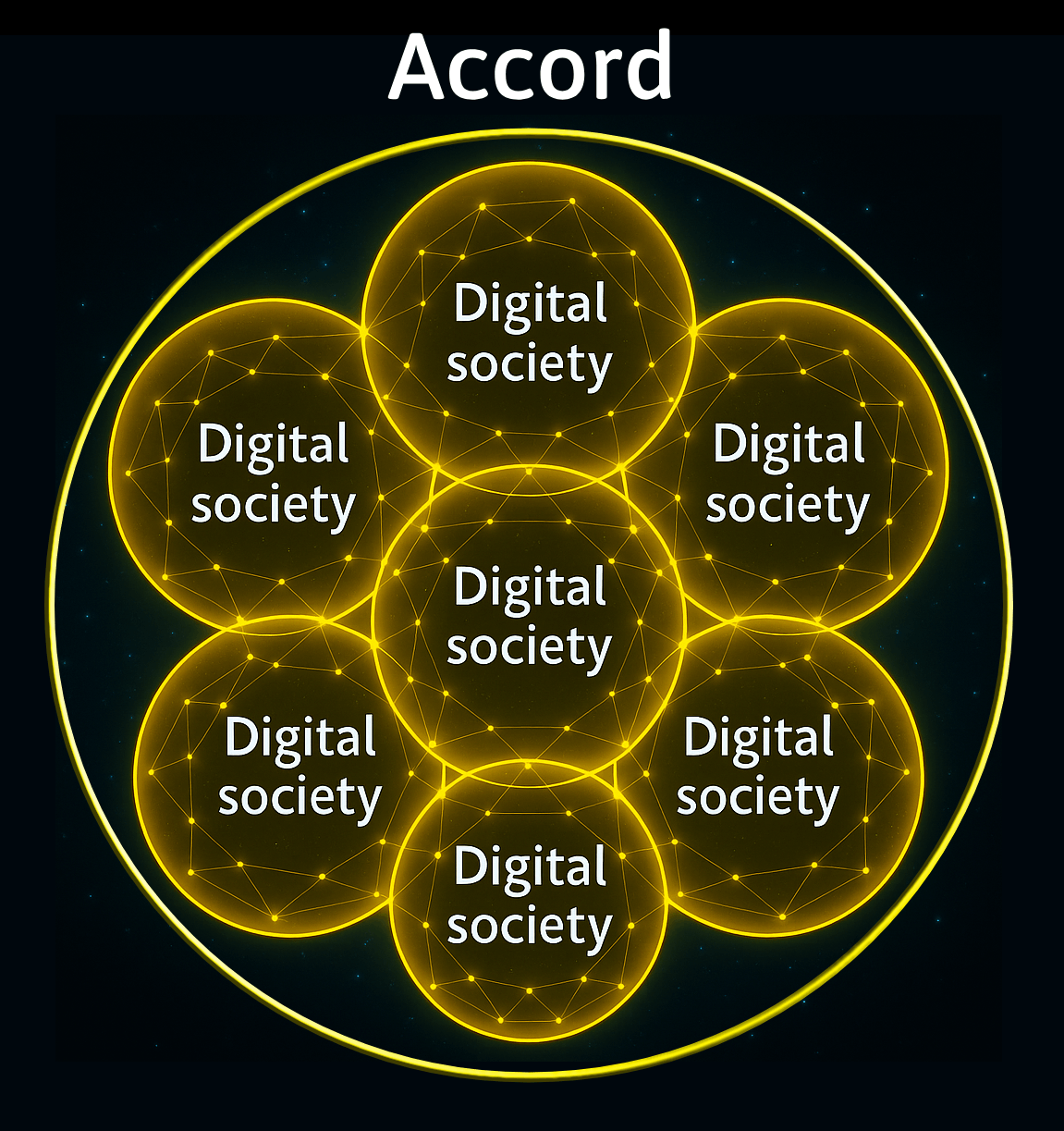
For example, Kyle and Edward, who are in two different societies, can have digital laws take precedence even though they're in different societies, provided those societies have signed up to an Accord.
Overlap: Accords
Digital societies can only be part of one Accord. When they join an Accord, the overlap principle naturally defaults to the Accords laws instead of the national government's laws.
In an Accord:
Digital society law → Accord law → National law
Outside of an Accord:
Digital society law → National law
Treaties
Digital societies and their accords can create treaties with one another to have certain matters dealt with according to predetermined sets of rules.
Let's say John belongs to digital society A and Sally belongs to digital society B. If they get into conflict and are not part of the same digital society or Accord, but their digital societies are part of Accords which have a treaty with one another, the dispute can be resolved according to the rules of the treaty.
Population threshold
Once a society reaches 30,000 citizens §, they are able to declare themselves Cyber Sovereign: an official digital society under Cyber Sovereignty. This milestone allows them to take precedence over national law from that point forward.
Corporations
Digital societies can allow corporations to register as citizens of that digital society. However, the corporation can only be judged by the digital society's laws when the corporation is dealing with a legal matter in which the first order effects are contained within the same digital society or its Accord.
Corporate citizenship analysis
A future article covers how corporations interact with digital societies. An exception includes the Visitor's jurisdiction.
Conflict of interest
An individual who holds a controlling position in a digital society may not also benefit from that society's laws. Namely, any person who is a key lawmaker, funder, elected president, or other essential entity, may not legislate to their own benefit. ◊
Citizenship
Everyone is free to associate with and operate in as many digital societies as they wish, but they can only become a citizen of one, and citizenship is the only means by which a person can be granted digital legal precedence. ‡
Protected from all sides
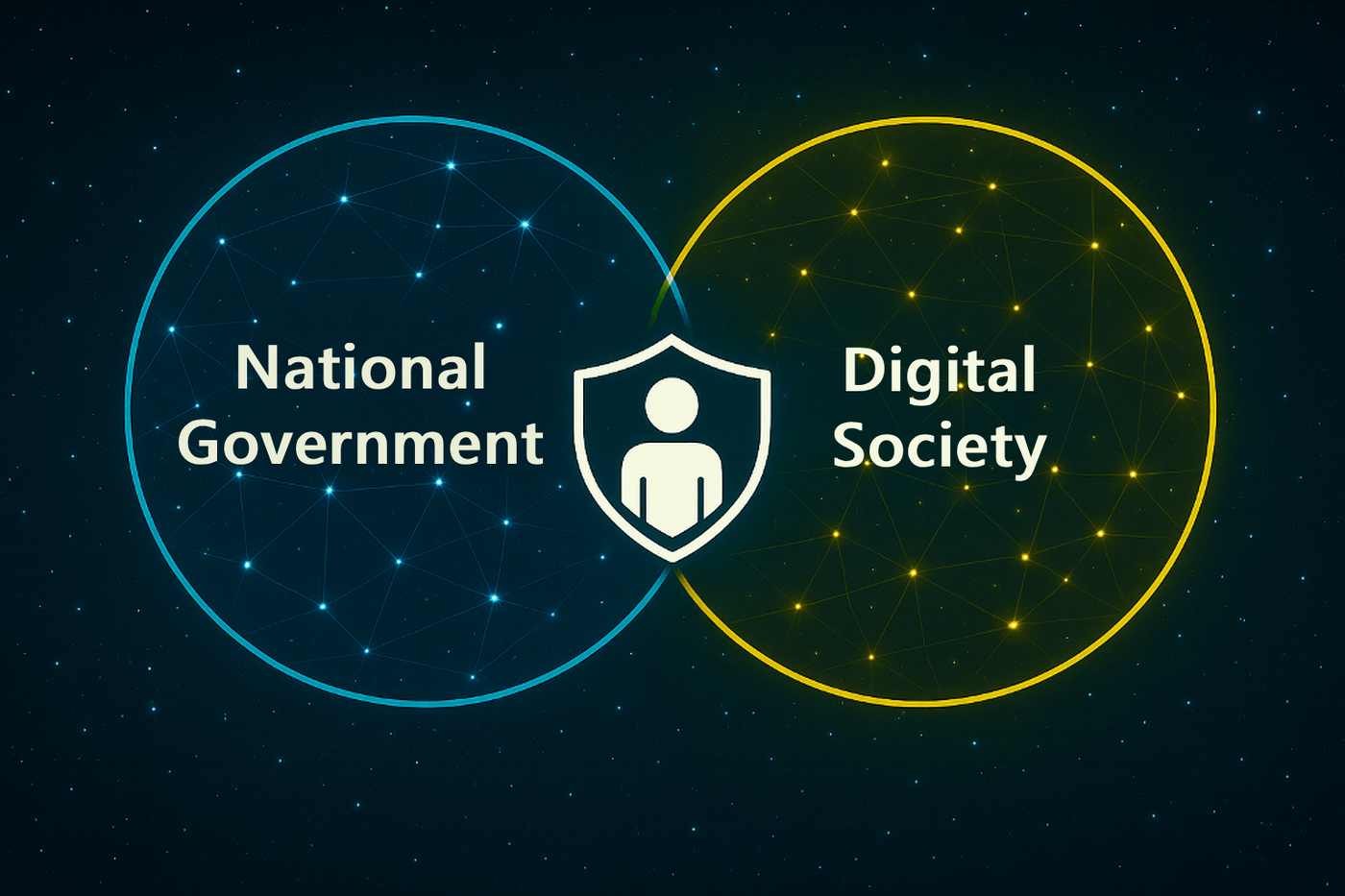
National governments ensure that digital societies don't infringe on individual rights and digital societies ensure that national governments don't infringe on the rights of their citizens.
The end result is that people's rights are protected from all sides.
National recognition
For the concept of Cyber Sovereignty to truly flourish, room has to be made within current legal systems to allow digital societies to take precedence in matters between citizens.
Cyber Sovereignty advocates for a three step process to create change:
Experiment with the creation of digital societies.
Promote media advocacy.
Pursue legal advocacy within current legal systems for digital society precedence.
(Step) 1: Experimentation
The best way to garner meaningful support for the cause is to demonstrate the value that digital societies can have. Cyber Sovereignty encourages people everywhere to create communities in the name of Cyber Sovereignty, and to create as much value as possible for those in their communities. This value is created by enabling profound connections between citizens, capably organizing society, or creating excellent systems of law and welfare.
The fundamental idea is for every community to work together to build a diverse digital civilization that puts humanity at the center.
(Step) 2: Media
The next step is to use media to showcase the value created.
(Step) 3: Legal
Once the new digital civilization is working for humanity, it becomes time to conform political reality to digital progress.
This is a call to everyone to work within current legal systems to create political parties which will push for constitutional amendments that implements Cyber Sovereignty and allows digital societies to take precedence over national laws.
Digital societies
In the next article, we take a look at what digital societies look like.
*, ❋, ‡, ⊛, §,◊ specific legal details
Disclaimers and legal notes are found in this article »